
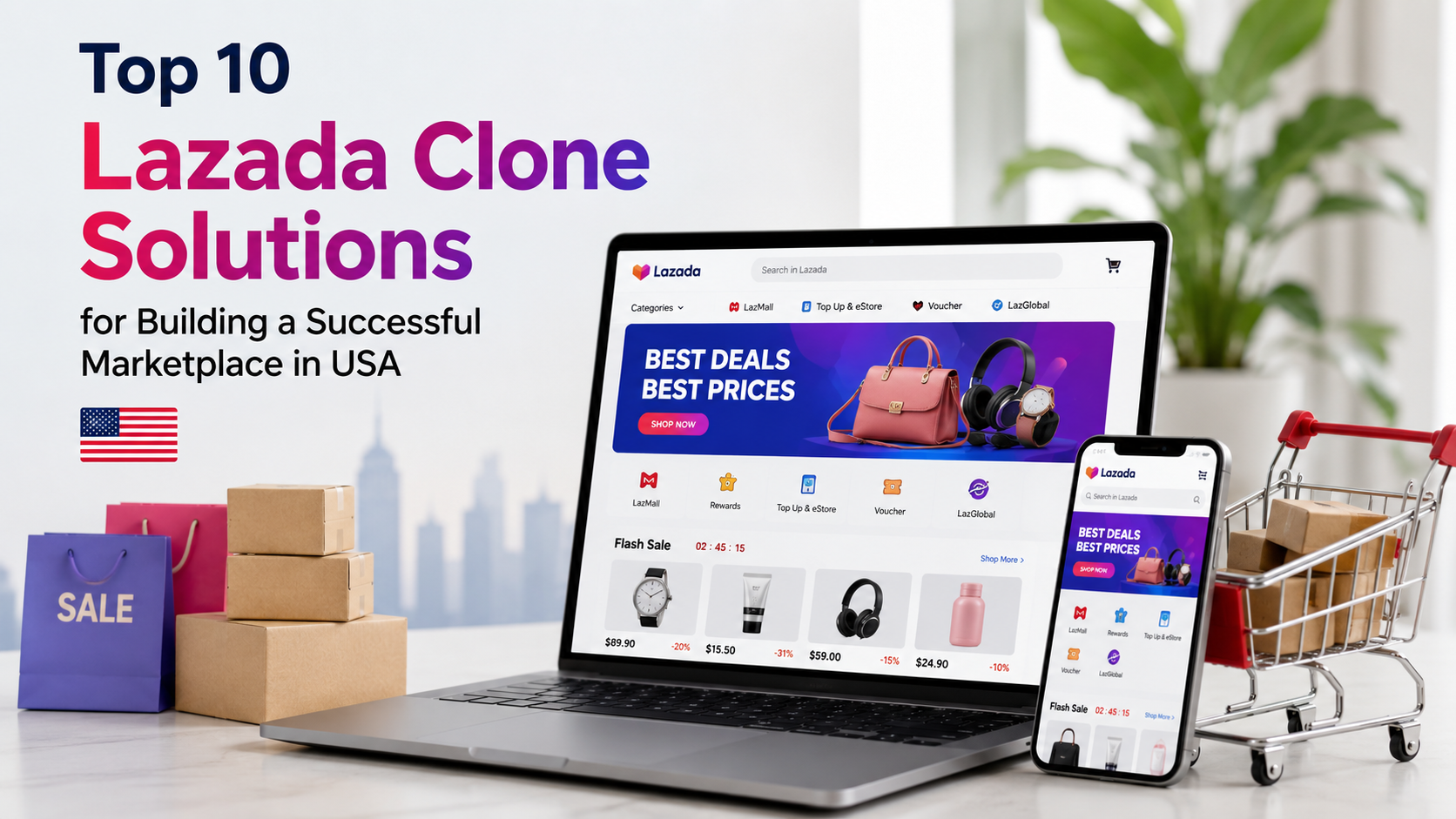
Building a marketplace inspired by Lazada can be an attractive business opportunity in the USA, especially for entrepreneurs targeting a specific product category, customer segment, or regional market. However, developing a multi-vendor marketplace from scratch can require significant time, technical expertise, and ongoing maintenance.
A Lazada clone solution provides a ready-made foundation for launching a marketplace where multiple sellers can register, list products, manage orders, receive payments, and serve customers through a centralized platform.
The important part is choosing software that can support the expectations of the US market, including flexible payment options, shipping integrations, seller management, mobile experiences, scalability, and strong administrative controls.
Below are 10 marketplace solutions worth considering in 2026.
What Is a Lazada Clone Solution?
A Lazada clone is marketplace software designed to replicate the core business model and functionality of a large multi-vendor ecommerce platform such as Lazada, without copying its branding, proprietary code, or intellectual property.
A typical solution allows:
- Multiple sellers to create storefronts
- Customers to browse products from different vendors
- Vendors to manage inventory and orders
- Marketplace owners to charge commissions
- Customers to make online payments
- Sellers to receive payouts
- Administrators to control users, products, categories, and transactions
For a US-focused marketplace, the software should also be adaptable to local payment, tax, shipping, compliance, and customer-service requirements.
How We Selected These Lazada Clone Solutions
Rather than focusing only on the number of features, it is better to evaluate marketplace software against practical requirements such as:
- Multi-vendor capabilities
- Customization options
- Scalability
- Payment integrations
- Shipping support
- Seller management
- Mobile compatibility
- API and integration capabilities
- Deployment flexibility
- Total ownership and maintenance requirements
Marketplace software comparisons published in 2026 similarly emphasize factors such as customization, scalability, ownership, deployment options, integrations, and marketplace functionality when evaluating platforms.
Top 10 Lazada Clone Solutions
1. Yo!Kart
Yo!Kart is a multi-vendor ecommerce marketplace solution designed for businesses that want to launch marketplaces similar to Amazon, eBay, Etsy, or other large multi-seller platforms.
Its marketplace-oriented architecture makes it relevant for entrepreneurs who want more than a basic ecommerce store with a marketplace plugin.
The platform supports multiple vendors, product management, order management, commissions, seller dashboards, customer accounts, and marketplace administration. Yo!Kart is also positioned as a white-label marketplace solution, allowing businesses to build their own branded marketplace.
Why consider it for a Lazada-style marketplace?
- Dedicated multi-vendor marketplace architecture
- Seller and administrator dashboards
- Multiple marketplace business models
- Customization options
- Mobile app support
- Payment and shipping integrations
- Suitable for niche as well as broad marketplaces
Yo!Kart is particularly worth considering when long-term ownership and customization are important considerations.
2. CS-Cart Multi-Vendor
CS-Cart Multi-Vendor is another established option for building a multi-seller ecommerce marketplace.
The platform is designed around the concept of multiple independent vendors operating through one marketplace. Vendors can manage products and orders while the marketplace owner manages the overall platform.
CS-Cart is especially relevant when you want a marketplace that resembles a traditional ecommerce shopping experience.
Key considerations:
- Multi-vendor product management
- Vendor storefronts
- Commission management
- Order management
- Multiple payment and shipping options
- Marketplace administration
- Customization through development
CS-Cart’s marketplace model is one reason it frequently appears in comparisons of marketplace software.
3. Sharetribe
Sharetribe takes a different approach from traditional ecommerce marketplace scripts.
It combines no-code marketplace creation with a developer platform that allows businesses to customize the marketplace with code. The platform supports listings, payments, monetization, user management, and other marketplace fundamentals.
It can be a good option when the goal is to validate a marketplace concept quickly before investing heavily in custom development.
However, for a highly complex product marketplace modeled closely on Lazada, entrepreneurs should carefully evaluate whether the platform’s ecommerce functionality matches their requirements. Sharetribe itself notes that it is not its strongest fit for Amazon- or Alibaba-style B2C/B2B product marketplaces.
Best suited for: Startups, niche marketplaces, and businesses prioritizing speed and flexibility.
4. Arcadier
Arcadier is an enterprise-focused marketplace platform supporting B2C, B2B, P2P, and service marketplace models.
Its API-first approach makes it particularly interesting for businesses that expect to integrate a marketplace with an existing technology ecosystem.
According to Arcadier, its platform provides more than 150 APIs and supports marketplace implementations across different business models.
Why consider Arcadier?
- Enterprise-oriented architecture
- API-first approach
- Multiple marketplace models
- Custom workflows
- Integration capabilities
- Scalable marketplace infrastructure
For a US business planning a larger marketplace operation, Arcadier may be worth evaluating alongside other enterprise solutions.
5. Mirakl
Mirakl is focused heavily on enterprise marketplace operations.
It is designed for organizations that need to integrate marketplace functionality into broader commerce ecosystems rather than simply launch a small marketplace website.
This makes it more appropriate for established retailers, brands, and enterprises with substantial technical and operational requirements.
Potential advantages include:
- Enterprise marketplace management
- Vendor onboarding
- Catalog management
- Workflow automation
- Integration capabilities
- Support for complex marketplace operations
If your planned Lazada-style marketplace is expected to operate at enterprise scale, Mirakl can be included in the evaluation process.
6. Marketplacer
Marketplacer is another marketplace platform aimed at businesses looking to add multi-vendor commerce capabilities to their existing business.
Instead of treating the marketplace as simply an online store, the platform focuses on enabling businesses to manage multiple sellers and marketplace operations.
Potential fit for a US marketplace:
- Multi-vendor commerce
- Seller onboarding
- Product and catalog management
- Marketplace administration
- Integration capabilities
- Support for different marketplace models
It is particularly relevant for organizations that already have an established ecommerce or retail operation and want to introduce a marketplace component.
7. Nautical Commerce
Nautical Commerce focuses on composable and multi-vendor marketplace commerce.
It can be considered when the business wants greater control over its commerce architecture and expects to integrate marketplace functionality with other systems.
The platform is particularly relevant to businesses building more sophisticated B2C or B2B marketplaces.
Key areas to evaluate include:
- Multi-vendor management
- Marketplace order orchestration
- Headless commerce capabilities
- API integrations
- B2B and B2C use cases
- Scalability
Nautical Commerce appears among marketplace platforms recommended for B2C and B2B product marketplaces in current marketplace software comparisons.
8. Adobe Commerce with Marketplace Extensions
Adobe Commerce can be used as the foundation for a marketplace by integrating suitable multi-vendor functionality.
The major advantage is the broader ecommerce ecosystem surrounding Adobe Commerce.
Businesses that already use Adobe Commerce may find this approach attractive because they can extend their existing commerce infrastructure rather than move to an entirely separate marketplace platform.
Advantages can include:
- Extensive ecommerce capabilities
- Large extension ecosystem
- Custom development possibilities
- Advanced catalog management
- Enterprise integrations
- Flexible storefront experiences
The downside is that turning a standard ecommerce platform into a sophisticated multi-vendor marketplace generally requires additional marketplace technology, development, configuration, and ongoing maintenance.
9. Shopify + Multi-Vendor Marketplace Solution
Shopify is primarily an ecommerce platform, but businesses can transform a Shopify store into a marketplace through third-party multi-vendor applications and custom development.
This approach can be appealing to entrepreneurs who already understand Shopify or want access to its broader ecommerce ecosystem.
However, it is important to distinguish between a native marketplace platform and an ecommerce platform extended into marketplace functionality.
Marketplace comparisons note that Shopify can be converted into a marketplace using multi-vendor apps or marketplace templates, but doing so can require additional technical work.
Best suited for: Businesses already invested in the Shopify ecosystem.
10. Magento Open Source + Multi-Vendor Marketplace Extension
Magento Open Source can also serve as the foundation for a Lazada-style marketplace when combined with appropriate multi-vendor extensions and custom development.
Its flexibility makes it suitable for businesses that have access to experienced Magento developers.
The approach can provide substantial control over:
- Product catalogs
- Customer accounts
- Checkout
- Promotions
- Seller functionality
- Marketplace workflows
- Integrations
However, the development and maintenance requirements can be considerably higher than using purpose-built marketplace software.
How to Choose the Right Lazada Clone Solution
There isn’t one universally best solution. The right choice depends on your marketplace model, budget, technical capabilities, and growth plans.
Use these questions to narrow down your options:
Do you need complete ownership?
If ownership and long-term control are priorities, investigate self-hosted or source-code-based solutions.
Are you trying to launch quickly?
SaaS and ready-to-use marketplace platforms can reduce infrastructure and initial development requirements.
Do you need extensive customization?
Look for software with APIs, developer access, modular architecture, and flexible workflows.
Are you targeting enterprise sellers?
Enterprise-focused platforms such as Mirakl, Marketplacer, and Arcadier may deserve closer evaluation.
Are you launching a niche marketplace?
A simpler marketplace platform may be sufficient and can help you validate demand before investing in advanced infrastructure.
Do you expect rapid seller growth?
Consider vendor management, catalog scalability, performance, search, order orchestration, and infrastructure requirements—not just the features available at launch.
Final Thoughts
A Lazada-inspired marketplace in the USA should not simply copy the appearance of a major ecommerce platform. The real challenge is building an ecosystem where customers, sellers, payments, products, orders, fulfillment, and marketplace operations work together efficiently.
Solutions such as Yo!Kart, CS-Cart, Sharetribe, Arcadier, Mirakl, Marketplacer, Nautical Commerce, Adobe Commerce, Shopify, and Magento provide different approaches to solving that challenge.
For a traditional multi-vendor ecommerce marketplace, purpose-built platforms such as Yo!Kart and CS-Cart can be strong starting points. For enterprise environments, Mirakl, Marketplacer, Arcadier, and Nautical Commerce are worth evaluating. Meanwhile, Sharetribe can make sense when rapid marketplace validation and developer extensibility are priorities.