

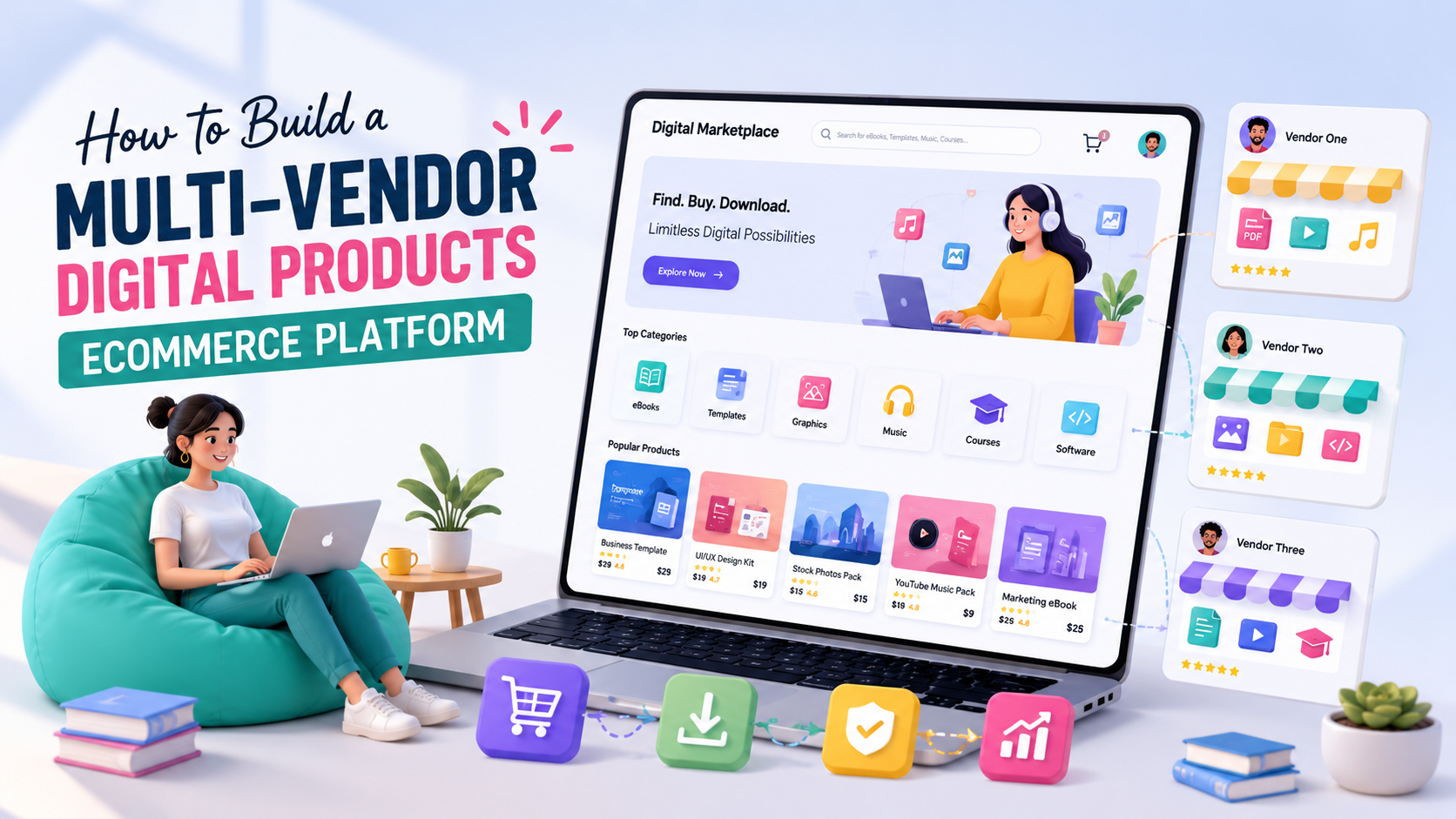
Selling digital products sounds simple until you need to manage multiple sellers, different file types, secure downloads, payments, commissions, refunds, and customer access from one platform.
A multi-vendor digital products ecommerce platform solves this by allowing multiple creators, developers, designers, educators, or businesses to sell digital products through a shared marketplace.
Think of products such as ebooks, templates, software, plugins, graphics, online courses, music, stock assets, or digital licenses.
If you’re planning to build one, here’s a practical roadmap.
What Is a Multi-Vendor Digital Products Ecommerce Platform?
A multi-vendor digital products ecommerce platform is an online marketplace where multiple independent sellers can upload, manage, promote, and sell digital products while the platform owner controls the overall marketplace.
The platform typically includes three primary interfaces:
- Buyer interface: Product discovery, checkout, downloads, reviews, and account management.
- Vendor interface: Product uploads, pricing, orders, earnings, analytics, and customer management.
- Admin panel: Vendor approvals, commissions, catalog moderation, payments, disputes, reports, and platform settings.
The business earns through commissions, subscription plans, listing fees, transaction fees, or a combination of these models.
Why Build a Digital Products Marketplace?
Digital products have a major operational advantage: there is no physical inventory, warehouse, or traditional shipping process.
Once a product is created, it can potentially be sold repeatedly with minimal fulfillment costs.
A marketplace can also create value for both sides:
Sellers: They get an existing storefront, payment infrastructure, audience, and marketplace tools.
Buyers: They get access to products from multiple creators in one place.
Marketplace owners: They can generate recurring revenue from transactions without producing every product themselves.
The challenge is building enough trust, convenience, and product quality to make both buyers and sellers stay on the platform.
How to Build a Multi-Vendor Digital Products Ecommerce Platform
1. Define Your Marketplace Niche
Don’t start by trying to sell every type of digital product.
A focused marketplace can be easier to position and market.
For example, you could build a marketplace specifically for:
- Design assets
- WordPress themes and plugins
- Business templates
- Online courses
- Ebooks
- Software and SaaS tools
- AI prompts
- Music and audio
- Photography and stock footage
- 3D models
- Marketing resources
Your niche will influence your product structure, search filters, licensing system, payment flow, and moderation policies.
2. Choose the Business Model
Before development, decide how the platform will make money.
Common models include:
Commission-based model:
The marketplace keeps a percentage from every transaction.
Subscription model:
Vendors pay a recurring fee to access premium marketplace features.
Listing fee:
Sellers pay to publish products.
Featured listing:
Vendors pay to promote products within search results or category pages.
Hybrid model:
You can combine commissions with subscriptions, listing fees, and promotional services.
For a new marketplace, a commission-based model can be attractive because sellers generally pay when they generate revenue.
3. Design the Vendor Registration Process
The vendor onboarding experience should be simple but controlled.
A typical flow can include:
- Vendor creates an account.
- Provides business or personal information.
- Completes verification where required.
- Adds payment details.
- Accepts marketplace terms.
- Submits products for approval.
- Starts selling after approval.
You can also introduce different vendor levels, such as standard and premium sellers, depending on your business model.
4. Build a Powerful Digital Product Catalog
Digital products require more than a basic product title and image.
Your product system should support:
- Product name
- Description
- Images or previews
- File uploads
- Product categories
- Tags
- Price
- License information
- Version information
- File format
- Product size
- Compatibility details
- Product updates
- Demo or preview links
For software products, you may also need version management and license-key functionality.
For courses, you may need lessons, videos, quizzes, and learning progress.
The catalog should therefore be flexible enough to support different digital product categories.
5. Add Secure Digital Delivery
This is one of the most important parts of the platform.
After a successful payment, the customer should receive authorized access to the purchased product without exposing the original file publicly.
Consider features such as:
- Secure download links
- Download expiration
- Download limits
- Customer authentication
- Protected file storage
- Access permissions
- Purchase history
- Automatic delivery emails
For premium content, additional protection such as watermarking, license keys, or controlled access may be appropriate.
Security should be designed into the architecture rather than added after launch.
6. Develop a Multi-Vendor Payment System
Payments become more complicated when one marketplace transaction involves multiple parties.
The system needs to track:
Customer payment → Platform commission → Vendor earnings → Refunds/payouts
Depending on your target market and payment providers, you may need marketplace payment capabilities that support seller onboarding, split payments, or managed payouts.
The platform should also maintain a clear transaction ledger so administrators and vendors can understand exactly how each payment was calculated.
7. Create Vendor Dashboards
A vendor dashboard should give sellers control over their business without requiring administrator assistance for everyday tasks.
Important features include:
- Product management
- Order management
- Sales reports
- Revenue tracking
- Customer information
- Reviews
- Coupons
- Product analytics
- Payout history
- Profile management
- Product performance
A good dashboard can significantly improve vendor retention because sellers can clearly see the value they’re getting from the marketplace.
8. Build an Easy Buyer Experience
Buyers should be able to discover and purchase products with minimal friction.
Your buyer-side platform should include:
- Search
- Category navigation
- Advanced filters
- Product previews
- Product reviews
- Wishlist
- Shopping cart
- Secure checkout
- Multiple payment options
- Download library
- Purchase history
- Order notifications
For digital marketplaces, product previews can be especially important because buyers cannot physically examine the product before purchasing.
9. Add Search and Discovery Features
A marketplace can have thousands or eventually millions of products.
Basic keyword search may not be enough.
Consider:
- Category-based browsing
- Filters
- Tags
- Price ranges
- Ratings
- Popular products
- New arrivals
- Best sellers
- Personalized recommendations
- Related products
AI-powered recommendations can eventually help users discover products based on browsing and purchasing behavior.
However, start with a strong search and categorization system before adding complex AI features.
10. Implement Reviews and Ratings
Trust is critical when customers are purchasing products from unfamiliar vendors.
Allow verified buyers to review products after purchase.
Useful review features include:
- Star ratings
- Written reviews
- Verified purchase badges
- Vendor responses
- Review moderation
- Helpful/not-helpful voting
Administrators should have moderation tools to identify spam, abusive content, and potentially fraudulent reviews.
11. Add Coupons and Promotional Tools
Vendors and administrators should have tools to drive sales.
You can support:
- Discount codes
- Percentage discounts
- Fixed discounts
- Limited-time offers
- Product bundles
- Vendor-specific promotions
- Marketplace-wide campaigns
- Featured products
You can also create promotional placements where vendors pay for additional visibility.
12. Build an Admin Dashboard
The admin dashboard is essentially the control center of your marketplace.
It should allow administrators to manage:
Vendor management
Approve, reject, suspend, or verify vendors.
Product management
Review, approve, edit, or remove listings.
Order management
Monitor purchases, cancellations, and refunds.
Commission management
Configure marketplace commission rules.
Payment management
Track transactions, vendor earnings, and payouts.
Customer management
Manage accounts, orders, reviews, and support requests.
Analytics
Monitor revenue, sales volume, active vendors, customers, and product performance.
13. Choose the Right Technology Stack
Your technology stack will depend on the expected marketplace size, product complexity, budget, and development approach.
A possible modern architecture could include:
Frontend: React, Next.js, or Vue.js
Backend: Node.js, Laravel, Django, or similar frameworks
Database: PostgreSQL or MySQL
Cloud: AWS, Google Cloud, or Microsoft Azure
Storage: Object storage such as Amazon S3
Search: Elasticsearch or OpenSearch
Payments: Marketplace-compatible payment gateway
CDN: Cloudflare or another content delivery network
You don’t necessarily need a highly complex architecture from day one.
For an MVP, prioritize reliability and scalability where it matters most—particularly payments, file storage, authentication, and product delivery.
14. Consider Using Ready-Made Marketplace Software
Building everything from scratch isn’t always necessary.
If your goal is to launch faster, you can consider a multi-vendor marketplace software solution with core functionality already available.
For example, FATbit Technologies’ Yo!Kart is a multi-vendor ecommerce platform that can be customized for marketplace businesses and adapted to specific business requirements.
This approach can reduce the amount of foundational marketplace functionality that needs to be developed from zero, while still allowing customization for your niche.
15. Test the Platform Before Launch
Don’t wait until launch day to discover that a vendor cannot upload a product or a customer cannot download a purchase.
Test the complete marketplace journey:
Vendor:
Registration → verification → product upload → approval → sale → earnings → payout
Buyer:
Registration → search → product view → cart → payment → download → review
Admin:
Vendor approval → product moderation → transaction management → commission → refund → reporting
Also test security, payment failures, file-access permissions, mobile responsiveness, performance, and unusual user scenarios.
Key Features to Include
A strong MVP should generally include:
- Multi-vendor registration
- Vendor dashboard
- Product management
- Digital file upload
- Product categories
- Search and filters
- Shopping cart
- Secure checkout
- Payment integration
- Automated digital delivery
- Vendor commissions
- Payout management
- Reviews and ratings
- Coupons
- Admin dashboard
- Reports and analytics
- Customer support
Advanced features such as AI recommendations, subscriptions, affiliate management, advanced licensing, and automated fraud detection can be introduced as the marketplace grows.
Common Challenges to Plan For
Building the platform is only one part of the challenge.
You also need to think about:
- Product piracy: Digital products can be copied and redistributed, so access controls and licensing mechanisms are important.
- Vendor quality: Poor-quality products can damage marketplace trust, making vendor and product moderation essential.
- Refund disputes: Digital products can require specific refund policies because customers may download products immediately after purchase.
- Payment compliance: Marketplace payment flows can involve additional verification and regulatory considerations depending on your countries and payment providers.
- Marketplace liquidity: You need enough quality products to attract buyers and enough buyers to make the marketplace worthwhile for sellers.
How Much Does It Cost to Build a Multi-Vendor Digital Products Marketplace?
The development cost depends heavily on the marketplace’s functionality and technical approach.
A basic MVP with vendor management, digital product listings, payments, secure downloads, and an admin panel will cost considerably less than a large marketplace with advanced recommendations, subscriptions, complex licensing, mobile apps, and sophisticated analytics.
Instead of focusing only on the initial development budget, consider the total cost of ownership, including hosting, payment processing, security, maintenance, third-party services, marketing, and future development.
Final Thoughts
A successful multi-vendor digital products ecommerce platform needs more than product listings and a checkout page. The real value comes from creating a reliable ecosystem where vendors can easily sell, buyers can confidently purchase, and the marketplace can securely manage transactions and digital delivery.
Start with a focused niche and a strong MVP, validate demand, and then expand features based on real user behavior. That approach can help you avoid overbuilding while creating a marketplace that is easier to scale.