

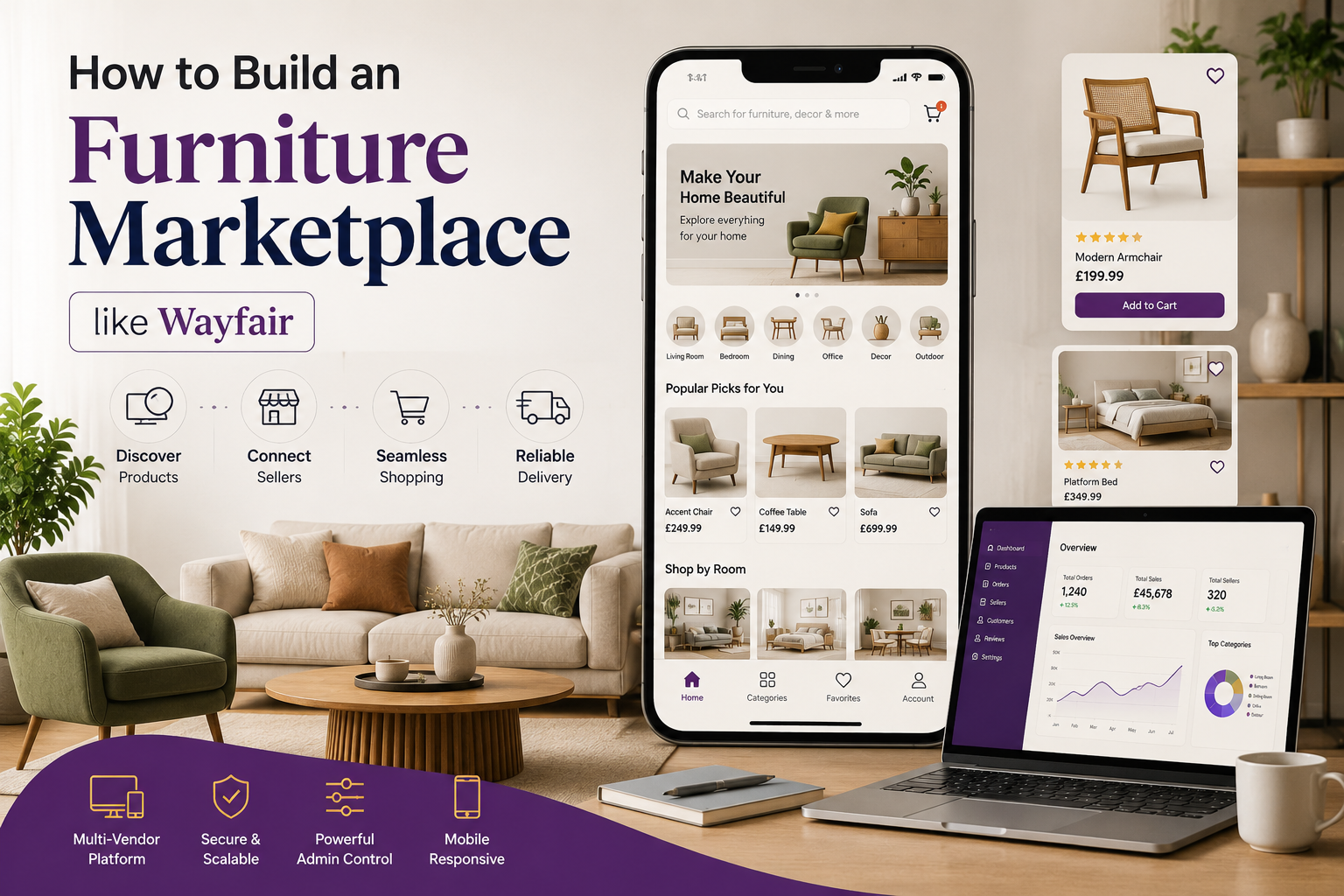
Building a furniture marketplace like Wayfair can be a strong business opportunity if you can combine a large product catalog with a smooth shopping experience, reliable delivery, and multiple seller support. Wayfair operates as a specialized home marketplace with millions of products and supplier-focused tools for catalog, inventory, fulfillment, and growth.
What Is a Furniture Marketplace Like Wayfair?
A Wayfair-like furniture marketplace is a multi-vendor ecommerce platform where furniture brands, manufacturers, retailers, and independent sellers can list and sell products directly to customers.
The platform owner manages the marketplace, while sellers handle their product inventory, fulfillment, and order operations based on the marketplace model.
How to Build a Furniture Marketplace Like Wayfair
1. Define Your Business Model
Start by deciding how your marketplace will operate. Common options include:
- Commission model: Charge sellers a percentage of every sale.
- Subscription model: Offer sellers monthly or annual plans.
- Listing fees: Charge vendors for publishing products.
- Advertising model: Allow sellers to promote products through sponsored placements.
- Hybrid model: Combine commissions, subscriptions, and advertising.
For a scalable marketplace, a hybrid approach can provide multiple revenue streams.
2. Choose Your Furniture Marketplace Niche
Instead of launching with every furniture category, consider starting with a focused segment such as:
- Home furniture
- Office furniture
- Outdoor furniture
- Luxury furniture
- Kids’ furniture
- Custom furniture
- Sustainable furniture
- Commercial furniture
You can expand categories after establishing demand.
3. Develop the Essential Marketplace Features
Your platform should include three primary interfaces: customer, seller, and admin.
Customer features:
- Advanced furniture search
- Category navigation
- Filters by size, material, color, style, and price
- High-quality product images
- Product videos and guides
- Product customization/options
- Reviews and ratings
- Wishlist
- Shopping cart
- Secure checkout
- Order tracking
- Returns and refunds
Detailed product information is especially important for furniture because dimensions, materials, weight, and images strongly influence purchase decisions. Wayfair itself emphasizes detailed specifications and multiple high-quality product images.
Seller features:
- Seller registration
- Product management
- Bulk catalog upload
- Inventory management
- Order management
- Shipping management
- Earnings dashboard
- Sales analytics
- Promotions
- Customer communication
Admin features:
- Seller management
- Product approval
- Commission management
- Order monitoring
- Payment management
- Content management
- Returns management
- Analytics and reports
- Promotional campaign management
4. Build a Strong Product Catalog
Furniture buyers need more information than typical ecommerce shoppers. Each product should include:
- Multiple product images
- Dimensions
- Materials
- Weight
- Colors and variants
- Assembly information
- Care instructions
- Delivery information
- Warranty details
- Product videos or guides
Wayfair recommends high-resolution imagery, detailed specifications, videos, and assembly guides to improve product merchandising.
5. Add Furniture-Specific Shopping Tools
To compete effectively, consider adding:
- Room-based browsing
- Style-based recommendations
- Compare products
- AR/3D visualization
- Room planner
- Furniture size guides
- Color and fabric swatches
- AI-powered recommendations
- Recently viewed products
- Personalized home collections
AI-powered discovery is becoming increasingly relevant in furniture ecommerce, with Wayfair investing in AI-powered shopping and personalized product discovery.
6. Implement Reliable Logistics
Furniture can be bulky, fragile, and expensive to transport, making logistics one of the most important parts of the business.
Your platform should support:
- Seller-managed shipping
- Third-party logistics
- Multiple warehouses
- Delivery scheduling
- Real-time tracking
- Large-item delivery
- White-glove delivery
- Installation services
- Returns management
Inventory synchronization is also critical because unavailable products should not remain purchasable.
7. Integrate Payments
Support secure payment methods suitable for your target market, including:
- Credit/debit cards
- Digital wallets
- Bank transfers
- Buy Now, Pay Later
- Seller payouts
- Automated commission deductions
- Refund processing
A marketplace payment system should automatically divide transaction amounts between the platform and sellers.
8. Add Seller Integrations
As your marketplace grows, manual order and inventory management can become difficult. API and EDI integrations can help sellers synchronize inventory, orders, and tracking information automatically.
9. Focus on SEO and Product Discovery
Furniture marketplaces depend heavily on product discovery. Optimize:
- Category pages
- Product pages
- Furniture buying guides
- Style-based landing pages
- Location pages
- Comparison content
- FAQs
- Image SEO
- Product schema
Create content around searches such as “modern bedroom furniture,” “best office desks,” “small apartment furniture,” and similar high-intent queries.
How to Monetize a Furniture Marketplace
Your marketplace can generate revenue through:
- Seller commissions
- Vendor subscriptions
- Product listing fees
- Featured product placements
- Sponsored listings
- Display advertising
- Premium seller tools
- Logistics or fulfillment services
- Installation services
Advertising can become particularly valuable once the platform has significant buyer traffic. Wayfair, for example, offers sponsored product and sponsored shop advertising for suppliers.
Technology Stack
A typical furniture marketplace may require:
- Frontend: React, Next.js, or similar technology
- Mobile apps: Flutter or React Native
- Backend: Node.js, PHP/Laravel, Python, or similar
- Database: MySQL, PostgreSQL, or MongoDB
- Cloud: AWS, Google Cloud, or Azure
- Payments: Stripe, PayPal, or regional payment gateways
- Search: Elasticsearch or Algolia
- Analytics: Google Analytics and marketplace dashboards
- AI: Recommendation, search, personalization, and visualization APIs
For a startup, using a ready-made multi-vendor marketplace solution can reduce development time. A fully custom platform makes more sense when you need highly specialized workflows, integrations, or user experiences.
How to Launch Your Wayfair-Like Marketplace
Follow a phased approach:
1: Research the market and select your niche.
2: Define the marketplace business and revenue model.
3: Build the MVP with customer, seller, and admin functionality.
4: Onboard furniture manufacturers, retailers, and suppliers.
5: Launch with a focused product catalog.
6: Invest in SEO, paid advertising, partnerships, and social media.
7: Add advanced capabilities such as AI recommendations, AR visualization, personalization, and automated logistics.
Conclusion
Building a furniture marketplace like Wayfair requires more than simply creating an ecommerce website. The real differentiators are product discovery, detailed furniture information, seller management, logistics, personalization, and customer trust.
Start with a focused niche and a strong MVP, then scale your catalog, seller network, technology, and fulfillment capabilities as demand grows.