
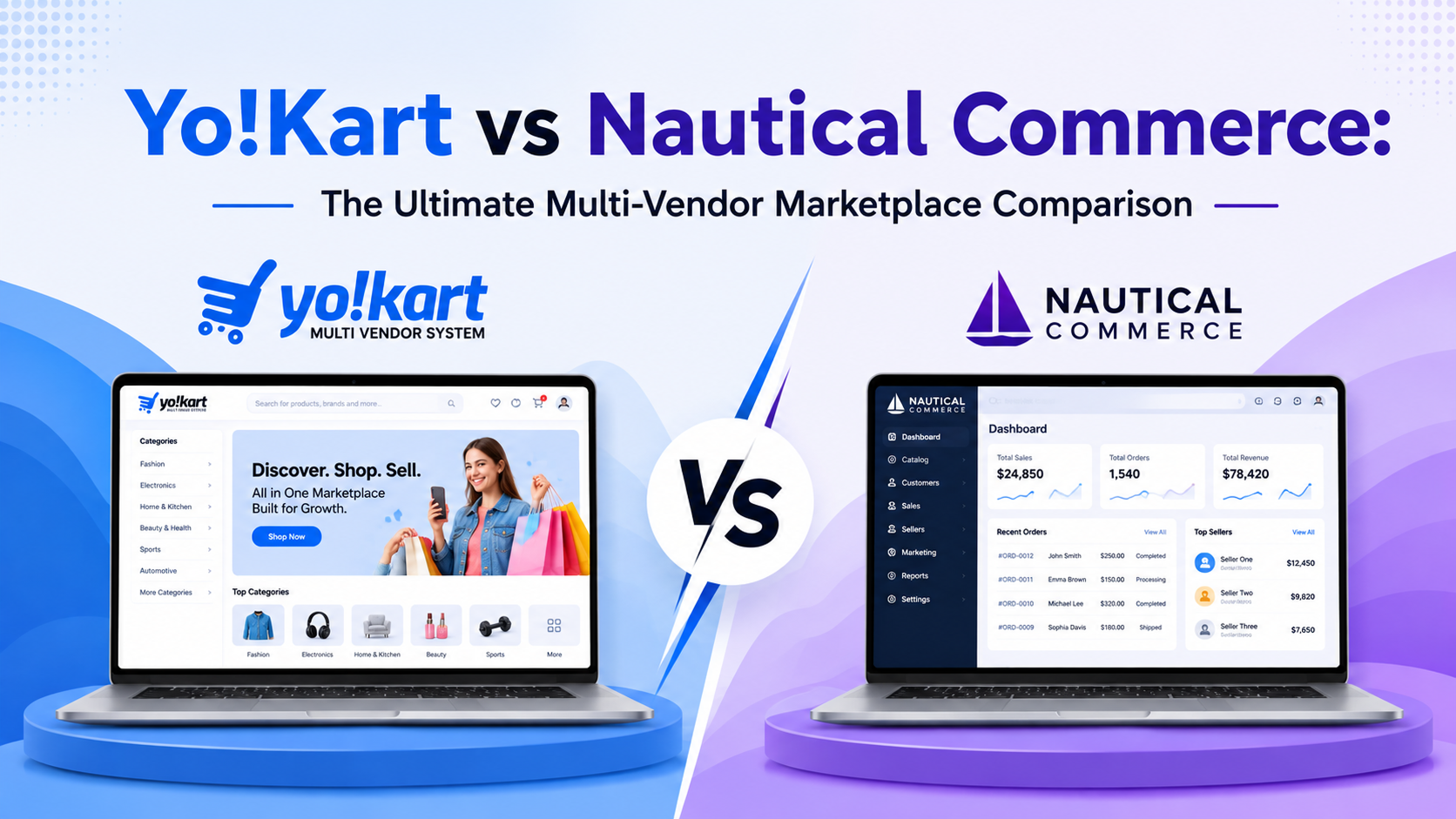
Launching a multi-vendor marketplace in 2026 requires more than simply putting products online. Businesses need a platform that can manage multiple sellers, product catalogs, commissions, payments, inventory, orders, shipping, customer relationships, analytics, and marketplace growth—all while providing enough flexibility to adapt to changing business requirements.
Two solutions that businesses may consider are Yo!Kart and Nautical Commerce. Both are designed to help businesses build and operate multi-vendor marketplaces, but they take different approaches to marketplace development and management.
Yo!Kart is a white-label, self-hosted multi-vendor marketplace solution designed for startups, SMBs, and enterprises. It provides built-in marketplace functionality, customizable source code, multiple business models, mobile apps, integrations, and a one-time licensing model. Yo!Kart states that it has supported 5,000+ businesses globally across 100+ countries and has more than 10 years of industry experience.
Nautical Commerce, meanwhile, is positioned as a cloud marketplace platform with an API-first approach. It focuses on helping merchants build and scale marketplaces while managing sellers, commissions, inventory, listings, orders, payments, and related marketplace operations.
So, which platform is the better choice for businesses looking to build a multi-vendor marketplace in 2026?
Let’s compare them.
Table of Contents
- Yo!Kart Overview
- Nautical Commerce Overview
- Yo!Kart vs Nautical Commerce: Feature Comparison
- Pricing and Ownership
- Customization and Scalability
- Marketplace Management
- Payments, Shipping, and Integrations
- Why Businesses Choose Yo!Kart for a Multi-Vendor Marketplace
- Who Should Choose Yo!Kart?
- Yo!Kart vs Nautical Commerce: Which Is Better?
- Conclusion
- FAQs
Yo!Kart Overview
Yo!Kart is a dedicated multi-vendor marketplace software designed to help businesses launch their own branded marketplace without building the entire platform from scratch.
The solution supports B2C, B2B, C2C, and hybrid marketplace models, allowing businesses to create marketplaces across industries such as fashion, furniture, electronics, grocery, pharmacy, digital products, auctions, and more.
One of Yo!Kart’s major advantages is that it comes with marketplace-specific functionality built into the platform. Businesses get separate dashboards for administrators, sellers, and buyers, along with features for product management, inventory, order management, shipping, payments, promotions, analytics, and more.
Yo!Kart is also self-hosted and offers customizable source code, allowing businesses to modify the platform according to their operational requirements. Its official platform information highlights features such as multi-currency, multilingual functionality, multicart checkout, separate vendor storefronts, product catalog management, multiple payment gateways, accounting, and third-party API integrations.
Another major differentiator is its ownership model. Yo!Kart offers a lifetime license with a one-time payment rather than requiring businesses to pay recurring software subscription fees.
Nautical Commerce Overview
Nautical Commerce is a marketplace technology platform designed around a modern cloud-based and API-first approach.
The platform helps businesses manage marketplace operations including sellers, commissions, inventory, product listings, orders, payments, and customer communications. It also offers tools intended to help merchants launch marketplace storefronts and scale their operations.
Its approach can be particularly attractive to businesses that already have a modern technology stack and want marketplace capabilities integrated into an existing digital commerce ecosystem.
Nautical’s API-first positioning gives businesses flexibility when building custom digital experiences. However, businesses evaluating it should consider whether a cloud-first architecture and API-led implementation align with their desired level of ownership, deployment control, customization, and long-term technology strategy.
Yo!Kart vs Nautical Commerce: Feature Comparison
| Feature | Yo!Kart | Nautical Commerce |
| Multi-vendor marketplace | Yes | Yes |
| White-label marketplace | Yes | Yes/Custom implementation |
| Self-hosted deployment | Yes | Cloud-focused |
| Customizable Source code | Yes | Not |
| Seller dashboards | Yes | Yes |
| Buyer experience | Yes | Yes |
| Admin dashboard | Yes | Yes |
| Product catalog management | Yes | Yes |
| Inventory management | Yes | Yes |
| Commission management | Yes | Yes |
| Order management | Yes | Yes |
| Multicart checkout | Yes | Marketplace capability |
| Multiple payment options | Yes | Yes |
| Shipping integrations | Yes | Yes |
| Multilingual capability | Yes | Integration/customization dependent |
| Multi-currency | Yes | Supported through platform/integrations |
| Mobile apps | Android & iOS buyer apps available | Custom implementation |
| API integrations | 40+ pre-integrated APIs/tools | API-first architecture |
| Customizable source code | Yes | API/custom development approach |
| Pricing model | One-time license options | Quote/subscription-based approach |
| Business models | B2B, B2C, C2C, hybrid | Primarily marketplace-focused |
| Lifetime license | Yes | No equivalent lifetime ownership model |
| Technical support | Up to 12 months included depending on package | Support based on plan |
Yo!Kart vs Nautical Commerce: Key Differences at a Glance
Compare Yo!Kart and Nautical Commerce across the factors that matter most when choosing a multi-vendor marketplace platform. From pricing and ownership to customization, marketplace management, payments, shipping, and integrations, understand how both platforms differ and which solution better fits your business needs.
Pricing and Ownership
Pricing can significantly influence the long-term profitability of a marketplace.
Yo!Kart follows a one-time license model, allowing businesses to purchase a license and own the software for lifetime use. Its currently published entry-level package starts at $1,249, with lifetime licensing and source-code ownership included.
This model can be attractive to entrepreneurs who want predictable software costs and greater control over their marketplace infrastructure.
Nautical Commerce follows a cloud software approach, meaning businesses should evaluate its ongoing commercial model, implementation requirements, infrastructure, integrations, and potential development costs when calculating total cost of ownership.
For businesses planning to operate a marketplace for many years, the difference between perpetual software ownership and recurring platform costs can become an important consideration.
Customization and Scalability
A marketplace rarely remains the same after launch.
As sellers join, customer expectations change, and new revenue models are introduced, businesses often need new features and integrations.
Yo!Kart provides access to customizable source code, enabling businesses to modify the marketplace according to their requirements. Its customization capabilities include custom web and mobile experiences, industry-specific designs, custom features, third-party API integrations, and additional backend functionality.
This gives businesses considerable control over their technology roadmap.
Nautical Commerce takes a different approach, emphasizing APIs and modern commerce architecture. This can be useful for organizations with an established development team that wants to build highly customized front-end experiences around marketplace infrastructure.
However, for businesses looking for a combination of ready-made marketplace functionality and source-code-level customization, Yo!Kart provides a more ownership-oriented proposition.
Marketplace Management
Managing a marketplace involves considerably more than adding sellers.
The administrator needs to control product approvals, categories, commissions, orders, payments, promotions, shipping, taxes, seller performance, and customer activity.
Yo!Kart provides dedicated dashboards and tools for these activities. Sellers can manage their storefronts, products, inventory, orders, fulfillment, and other operations, while administrators retain control over marketplace-wide settings.
The platform also supports separate vendor storefronts, multicart checkout, product catalogs, order management, discounts, analytics, and fulfillment workflows.
Yo!Kart also supports multiple marketplace revenue channels, including commissions, subscriptions, promotional banners, featured products, and PPC advertising.
For marketplace operators who want multiple monetization strategies, this built-in functionality can reduce the need for extensive custom development.
Payments, Shipping, and Integrations
Payments and logistics can make or break the customer experience of a multi-vendor marketplace.
Yo!Kart comes with multiple payment options and pre-integrated business APIs. Its official platform information highlights integrations covering payments, shipping, taxes, analytics, SMS, and other business functions.
The platform supports payment methods such as Stripe Connect, cards, wallets, COD, and other payment options. Shipping integrations include services such as ShipStation, AfterShip, Shiprocket, EasyPost, Aramex, and ShipEngine, depending on the required implementation.
Nautical’s API-first architecture can be advantageous for businesses that want to connect marketplace functionality with an existing technology ecosystem.
The choice therefore depends on the business’s technical strategy. Organizations wanting ready-made integrations and marketplace functionality may find Yo!Kart more convenient, while organizations building highly customized technology stacks may prefer an API-centric approach.
Also Read:- 50 Must-Have Features for a Multi-Vendor Marketplace in 2026
Why Businesses Choose Yo!Kart for a Multi-Vendor Marketplace
There are several reasons businesses can choose Yo!Kart when building a multi-vendor marketplace in 2026.
1. Pay Once and Own the Software
One of Yo!Kart’s strongest advantages is its lifetime licensing model. Instead of depending on recurring marketplace software subscriptions, businesses can purchase a license and retain long-term ownership of the platform.
2. Ready-to-Launch Marketplace Functionality
Businesses do not have to build basic marketplace infrastructure from the ground up. Yo!Kart includes essential features for sellers, buyers, administrators, products, orders, payments, shipping, inventory, and marketplace management.
This can significantly reduce the time and complexity involved in launching a marketplace.
3. Complete White-Label Experience
Yo!Kart allows businesses to operate the marketplace under their own brand. Branding elements such as logo, theme, colors, and other visual components can be customized to create a branded marketplace experience.
4. Customizable Source Code
Businesses have access to customizable source code, making Yo!Kart suitable for organizations that expect to introduce unique workflows or features as they grow.
5. Supports Multiple Business Models
Whether the goal is to launch a B2C marketplace, B2B marketplace, C2C platform, or hybrid marketplace, Yo!Kart provides flexibility to support different models.
6. Built for Different Industries
Yo!Kart can be used to build marketplaces across multiple verticals, including furniture, fashion, electronics, grocery, pharmacy, digital products, auctions, and more.
7. Mobile Apps
Mobile commerce is essential for modern marketplaces. Yo!Kart offers buyer apps for Android and iOS, allowing businesses to extend their marketplace experience beyond the website.
8. Strong Integration Ecosystem
With numerous pre-integrated APIs and tools for payments, shipping, taxes, analytics, communication, and other business processes, Yo!Kart helps businesses establish an operational marketplace without depending entirely on custom integrations.
9. Scalable and Customizable Architecture
As the marketplace expands, businesses can introduce new features, integrations, workflows, and industry-specific capabilities. Yo!Kart is positioned as a scalable solution for startups, SMBs, and enterprises.
10. Dedicated Marketplace Expertise
Yo!Kart is specifically built around multi-vendor commerce rather than being a generic website builder that requires marketplace functionality to be assembled separately.
Its experience across multiple marketplace projects gives businesses access to a solution designed around the practical requirements of multi-vendor commerce.
Who Should Choose Yo!Kart?
Yo!Kart is a strong choice for:
- Entrepreneurs launching their first multi-vendor marketplace
- Startups looking for a ready-to-launch solution
- Established businesses entering marketplace commerce
- Enterprises requiring extensive customization
- B2B marketplace operators
- B2C marketplace businesses
- Businesses seeking white-label marketplace software
- Companies that prefer self-hosted deployment
- Businesses wanting source-code ownership
- Organizations looking to avoid recurring marketplace software fees
Its flexibility also makes it suitable for businesses that want to begin with an MVP and gradually add custom functionality as the marketplace grows.
Yo!Kart vs Nautical Commerce: Which Is Better?
There is no universal marketplace platform for every business. The right solution depends on technical requirements, ownership preferences, budget, deployment strategy, and growth plans.
Nautical Commerce can be a compelling option for businesses looking for a modern cloud-based, API-first marketplace architecture and those with an existing technology team capable of creating customized experiences around the platform.
However, Yo!Kart is the stronger choice for businesses that want a complete, customizable, white-label multi-vendor marketplace with greater ownership and control.
Its combination of ready-made marketplace features, self-hosting, customizable source code, mobile applications, multiple integrations, multiple business models, and lifetime licensing makes it particularly attractive for businesses that want to build a long-term marketplace asset rather than simply subscribe to marketplace infrastructure.
The ability to pay once and own the software can also make Yo!Kart an appealing option for entrepreneurs focused on controlling long-term technology costs.
Conclusion
The multi-vendor marketplace industry continues to evolve in 2026, and choosing the right technology foundation is critical for long-term success.
Nautical Commerce offers a modern API-first marketplace approach that can suit businesses looking for cloud-based infrastructure and flexible digital experiences.
Yo!Kart, however, stands out for businesses that want ownership, customization, scalability, and a ready-to-launch marketplace ecosystem. Its built-in marketplace functionality, white-label capabilities, self-hosted deployment, customizable source code, mobile apps, integrations, and lifetime licensing provide businesses with a strong foundation for launching and growing their marketplace.
For entrepreneurs and businesses that want more control over their marketplace technology and long-term costs, Yo!Kart is a compelling choice for building a multi-vendor marketplace in 2026 and beyond.
12. FAQs
Is Yo!Kart better than Nautical Commerce for a multi-vendor marketplace?
Yo!Kart can be a better fit for businesses that prioritize self-hosting, source-code ownership, white-label branding, ready-made marketplace features, and a one-time licensing model. Nautical Commerce may be more suitable for businesses seeking a cloud-based and API-first marketplace approach.
Does Yo!Kart support B2B and B2C marketplaces?
Yes. Yo!Kart supports B2B, B2C, C2C, and hybrid marketplace models, making it suitable for different business strategies.
Does Yo!Kart offer a lifetime license?
Yes. Yo!Kart follows a one-time licensing model that provides lifetime use of the purchased software license.
Can Yo!Kart be customized?
Yes. Yo!Kart provides customizable source code and supports custom features, third-party integrations, web and mobile experiences, and industry-specific marketplace requirements.
Does Yo!Kart provide mobile apps?
Yes. Yo!Kart offers buyer applications for both Android and iOS, allowing businesses to extend their marketplace experience to mobile users.
Why should a business choose Yo!Kart in 2026?
Businesses can choose Yo!Kart for its combination of ready-made multi-vendor functionality, white-label branding, customizable source code, self-hosting, mobile apps, multiple integrations, flexible business models, and lifetime software ownership. These capabilities make it a practical option for businesses planning to build and scale their own marketplace.