
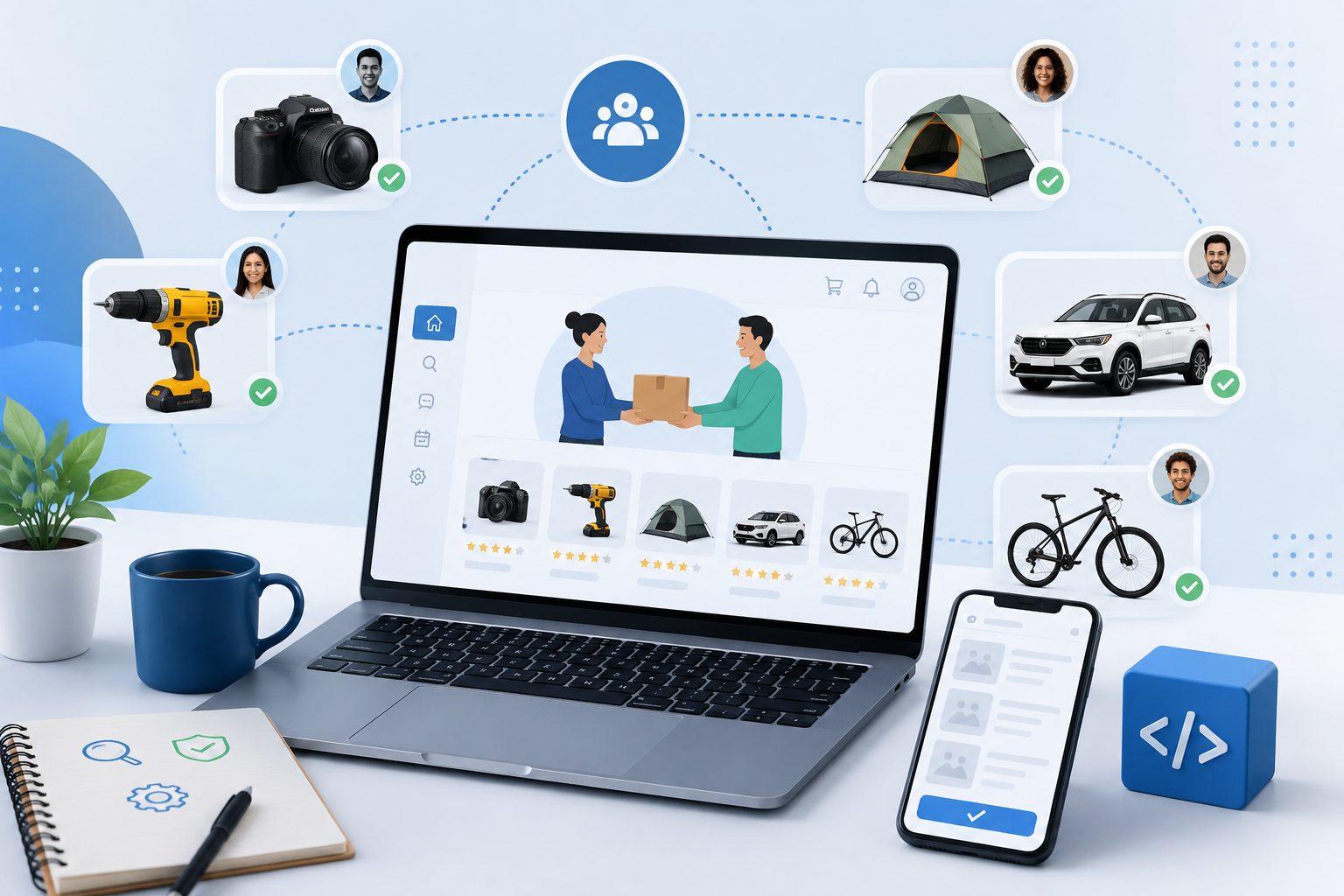
The peer-to-peer rental economy is creating new opportunities for startups to connect people who own underutilized assets with customers who want temporary access to them. From vehicles and cameras to tools, sports equipment, furniture, and event supplies, P2P rental marketplaces can serve a wide range of customer needs without requiring the marketplace owner to maintain physical inventory.
However, launching this type of business requires more than simply creating a website where people can list and rent products. You need software that can manage listings, availability, bookings, payments, security deposits, commissions, communication, and multiple user accounts while providing a smooth experience for both owners and renters. Choosing the right P2P rental marketplace software can therefore have a major impact on your startup’s launch speed, operating costs, scalability, and long-term growth.
What Is P2P Rental Marketplace Software?
P2P rental marketplace software is a ready-made or customizable technology solution that helps entrepreneurs build an online marketplace where individuals or businesses can list assets for rent and customers can discover, book, and pay for those assets.
Unlike a traditional rental website, a P2P marketplace usually has at least three major user groups: marketplace administrators, product owners, and renters. Each group requires different functionality.
Owners need tools to create listings, set rental prices, define availability, manage bookings, and communicate with customers. Renters need search, filters, booking calendars, secure payments, and order tracking. Meanwhile, administrators need centralized controls for users, commissions, listings, transactions, disputes, and marketplace policies.
Because of these requirements, selecting software based only on its appearance or price can lead to expensive limitations later.
Key Factors to Consider When Choosing P2P Rental Marketplace Software
1. Define Your P2P Rental Business Model
Before comparing software solutions, clearly define how your marketplace will operate. In a P2P model, individuals or independent suppliers list their assets while other users rent them for a specific period.
Start by identifying:
- What products or assets will users rent?
- Who will be your primary suppliers and renters?
- Will you support hourly, daily, weekly, or monthly rentals?
- Will owners handle delivery, or will your business manage logistics?
- Will users be allowed to rent and sell products?
- How will you generate revenue?
Your answers will help determine which software capabilities are essential. A marketplace for sports equipment may require different workflows from a car-sharing or fashion rental marketplace.
It is also better to begin with a focused niche rather than trying to support every rental category from day one. A clearly defined target market can simplify operations, marketing, inventory onboarding, and customer acquisition.
2. Look for Dedicated Rental Features
A conventional eCommerce marketplace is not automatically suitable for rental businesses. Rentals involve availability, booking periods, returns, deposits, extensions, cancellations, and potentially product-condition disputes.
Therefore, prioritize software with rental-specific functionality such as:
- Rental booking calendars
- Real-time availability management
- Security deposits
- Rental agreements
- Cancellation and return management
- Availability buffers
- Pickup and delivery options
- Rental invoicing
For example, a booking calendar should allow renters to select dates while preventing owners from accepting overlapping reservations. This can significantly reduce manual intervention and double-booking issues. Rental-specific software is increasingly recognized as an important consideration when selecting marketplace technology.
3. Evaluate Seller and Owner Management
P2P marketplaces have two important sides: people looking to rent and people offering assets for rent. Your software should provide dedicated functionality for owners to manage their listings without depending on the administrator for every task.
Look for features that allow owners to:
- Create and edit listings
- Upload product images and descriptions
- Set rental prices
- Define availability
- Manage bookings
- Track returns
- View earnings
- Respond to customer inquiries
At the same time, administrators should be able to approve sellers, manage listings, monitor transactions, configure commissions, and enforce marketplace policies.
A smooth owner experience is particularly important during the early stages of a startup because attracting quality supply can be just as challenging as attracting customers.
4. Prioritize Trust, Safety, and Verification
Trust is one of the biggest challenges in P2P rentals. Unlike traditional retail, users may be renting valuable items from individuals they do not know.
The software should therefore support mechanisms that make transactions safer. Important capabilities include identity verification, seller approval, security deposits, rental agreements, ratings and reviews, and transaction records.
Security deposits can provide an additional layer of protection against damage or other rental-related issues. Some rental software also allows the deposit to be partially or fully refunded depending on the condition of the returned item.
You should also check whether the software supports secure payment processing and appropriate data-security practices. The objective is to create a marketplace where both renters and owners feel confident participating.
5. Check the Booking and Payment Workflow
A complicated checkout process can result in abandoned bookings. Your software should make the journey from discovery to completed rental straightforward.
Ideally, the workflow should allow a renter to:
- Search for an item.
- Select a rental period.
- Check availability.
- Review pricing and deposit requirements.
- Submit a booking request or confirm instantly.
- Complete payment securely.
- Receive booking confirmation.
- Track the rental and return process.
For owners, the system should provide clear visibility into upcoming bookings, earnings, cancellations, and returns.
Also examine the available payment options. If your startup plans to operate internationally, multi-currency support and multiple payment gateways can become important requirements. Yo!Rent, for example, supports multiple currencies and payment integrations as part of its rental software capabilities.
6. Examine Monetization Options
Your marketplace needs a sustainable revenue model. Good software should give you flexibility rather than forcing you into a single monetization strategy.
Common revenue models include:
- Commission on rental transactions
- Subscription plans for owners
- Listing fees
- Featured listing charges
- Advertising or promotional fees
- Additional service charges
Choose software that allows you to configure commissions and other charges according to your business strategy. This becomes especially useful when you introduce different seller tiers, premium services, or promotional campaigns.
7. Make Sure the Software Is Customizable
Your startup may begin with a relatively simple concept, but your requirements can change after you start receiving feedback from customers and owners.
For this reason, customization is an important consideration. Check whether you can modify:
- Website design and branding
- Listing fields
- Rental workflows
- Commission structures
- Payment methods
- Notifications
- Search filters
A customizable solution allows you to adapt the marketplace instead of rebuilding the entire system whenever your business model evolves.
8. Consider Scalability From the Beginning
Scalability does not only mean handling more website visitors. A growing P2P rental marketplace may eventually have thousands of listings, multiple product categories, more transactions, additional administrators, and users across different regions.
Ask software providers how their solution handles:
- Increasing inventory
- Growing user volumes
- Higher transaction numbers
- Multiple locations
- Multiple languages and currencies
- New rental categories
- Third-party integrations
- Mobile usage
Choosing scalable software early can prevent expensive technology migrations later.
9. Compare Total Cost of Ownership
Price should not be the only deciding factor. A seemingly inexpensive solution can become expensive if it requires extensive development, multiple paid extensions, ongoing maintenance, or frequent technical support.
Compare the total cost, including:
- Software license or subscription
- Customization
- Hosting
- Payment gateway charges
- Mobile applications
- Third-party integrations
- Maintenance
- Technical support
- Future upgrades
Also understand the licensing model. Some solutions operate on recurring subscriptions, while others may offer a one-time license. Your preferred model should align with your startup’s available capital and long-term financial strategy.
10. Test the User Experience Before Buying
A feature-rich system is not useful if users find it difficult to navigate. Before purchasing software, test the actual workflows from the perspective of both renters and owners.
Pay attention to:
- Search experience
- Listing presentation
- Booking flow
- Checkout process
- Owner dashboard
- Mobile responsiveness
- Navigation
- Notifications
- Account management
If possible, request a live demo and perform a complete test booking. This can reveal usability problems that may not be apparent from a feature list.
Common Mistakes to Avoid
Startups often make the mistake of choosing software because it has the lowest price or the largest feature list. Neither approach guarantees the right fit.
Avoid selecting software without checking rental-specific workflows. Do not assume that an ordinary eCommerce solution can automatically handle rental availability, deposits, returns, and booking schedules.
You should also avoid overbuilding at the beginning. Instead of investing in dozens of unnecessary features, identify the core workflow required to validate your marketplace idea. Once you establish product-market fit, you can expand functionality based on real user needs.
Another common mistake is overlooking the owner experience. A P2P marketplace cannot grow if suppliers find the listing and booking process difficult. Both sides of the marketplace need a simple and reliable user experience.
Final Thoughts
Choosing the right software is one of the most important technology decisions for a peer-to-peer rental startup. The ideal solution should combine rental-specific functionality, secure transactions, easy owner management, a smooth renter experience, customization, scalability, and sustainable pricing.
Avoid choosing software simply because it is inexpensive or has an impressive feature list. Instead, focus on how well it supports your business model today and how easily it can adapt to tomorrow’s requirements. A solution such as Yo!Rent can be considered by startups looking for customizable rental software that supports P2P, B2B, and B2C rental business models and includes capabilities such as booking management, security deposits, seller management, dynamic pricing, and multi-vendor operations.
Ultimately, the best choice is the software that helps you launch efficiently, establish trust between owners and renters, manage daily operations effectively, and create a strong foundation for long-term marketplace growth.