
The way people search for information online is changing. In the past, people usually entered a keyword into Google, opened different websites, and compared the information themselves. Today, many users ask complete questions to AI-powered platforms and receive direct answers within seconds.
For example, someone might ask, “How can I improve my website’s Google rankings?” Instead of visiting several websites, the person may receive a detailed answer from ChatGPT, Google AI Overviews, Perplexity, or another AI-powered search tool.
This change creates a new opportunity for website owners, content creators, and digital marketers. They can optimize their content not only to appear in traditional search results but also to become a source used in AI-generated answers.
This approach is known as Answer Engine Optimization (AEO).
AEO helps businesses make their information easier to discover, understand, and use when search engines or AI assistants answer questions. It combines useful content, traditional SEO, clear page structure, reliable information, and a trustworthy online presence.
In this guide, you will learn what AEO means, how it works, why it matters, and how to implement it on your website.
What Is AEO?
AEO stands for Answer Engine Optimization. It is the process of improving website content so that search engines, voice assistants, and AI-powered answer platforms can identify and use it to answer relevant user questions.
Traditional SEO often focuses on improving a website’s visibility in search engine results pages. AEO places additional emphasis on making content suitable for direct answers, featured snippets, voice responses, and citations in AI-generated results.
For example, imagine that you publish an article about website indexing problems.
A user asks an AI assistant, “Why is my website not indexed by Google?”
If your article clearly explains common indexing problems, provides accurate solutions, and is accessible to the relevant search systems, it may become a source for the generated answer.
However, publishing a helpful article does not guarantee that an AI platform will select or cite it. Each platform uses its own systems to retrieve, evaluate, and present information.
The primary goal of AEO is to improve your chances of being selected as a useful and reliable source.
What Is an Answer Engine?
An answer engine is a system that helps users find answers to their questions rather than simply presenting a list of webpages.
Examples of answer-oriented search experiences include:
- Google AI Overviews, which provide AI-generated summaries within Google Search.
- ChatGPT search, which can answer questions using information retrieved from the web.
- Perplexity, which provides conversational answers with source references.
- Microsoft Copilot, which can combine conversational responses with web information.
- Featured snippets and certain voice-assistant experiences that provide direct answers.
These platforms do not all work in the same way. Some rely heavily on live web retrieval, while others may combine multiple information sources and different retrieval methods.
For website owners, the practical objective is similar: make accurate, relevant information available in a format that these systems can understand and potentially use.
How Does AEO Work?
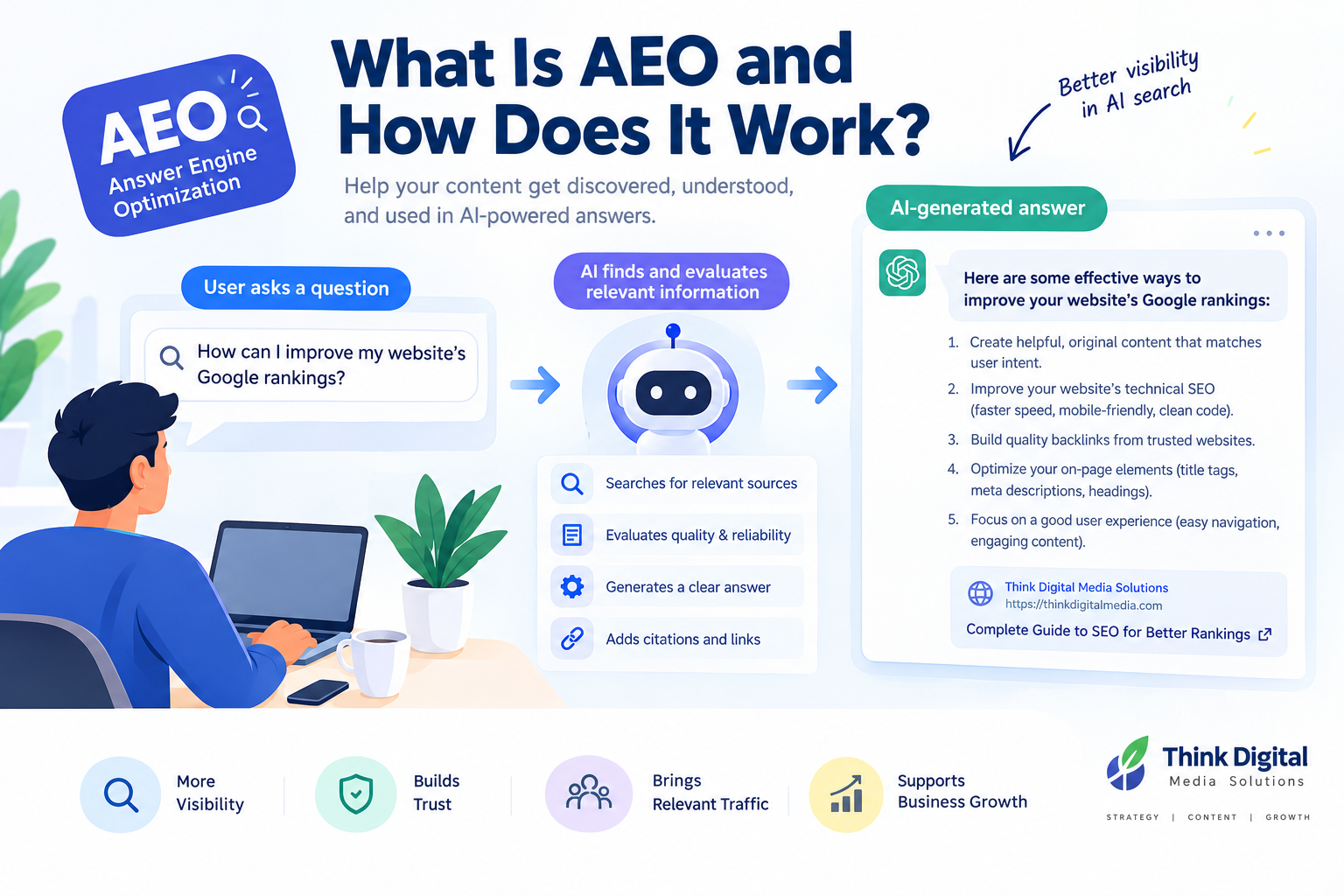
AEO works by improving the chances that your content will be discovered, understood, considered relevant, and selected when a system generates an answer.
The process can be understood through five main stages.
1. A User Asks a Question
The process begins when someone enters a question into a search engine or AI assistant.
For example:
- How does technical SEO work?
- Why is my website not appearing on Google?
- Which SEO techniques help local businesses?
- How can a new business attract customers online?
These questions reveal what the user wants to understand or accomplish.
AEO starts with understanding this intent. Instead of focusing only on a short keyword, you should consider the complete question, its context, and the information needed to answer it properly.
For example, the keyword “website indexing” is broad. A more specific question, such as “How can I check whether Google has indexed my website?”, provides a clearer direction for your content.
2. The System Finds Relevant Information
When an answer engine uses live search or retrieval, it may identify relevant webpages and other information sources.
For Google AI features, Google’s official guidance explains that AI experiences can use its search index and retrieval techniques to find relevant information. Some queries may also lead to additional related searches to gather information about different aspects of the question.
This means your website needs a sound technical foundation.
Important checks include:
- Make sure important pages can be crawled.
- Check that pages intended for search are not accidentally marked noindex.
- Use an XML sitemap to help search engines discover your URLs.
- Fix broken internal links and important crawl errors.
- Use descriptive URLs and a logical website structure.
- Make important information available in accessible page content.
A page that cannot be discovered or is excluded from a particular search system may have fewer opportunities to appear in its results.
Remember that crawling, indexing, ranking, and appearing in an AI answer are separate processes. Passing one stage does not guarantee the next.
3. The System Evaluates Relevant Content
After finding potentially useful information, the system must determine which sources and passages are suitable for the question.
Relevance is important, but it is not the only consideration. Accuracy, context, source reliability, freshness when relevant, and the overall usefulness of the information can also matter.
Suppose two websites discuss website speed.
The first website says that a slow website may create a poor user experience.
The second website explains common causes of slow loading, describes how to test performance, and provides practical troubleshooting steps.
For a user asking how to improve website speed, the second article may provide more directly useful information.
This is why AEO content should go beyond repeating definitions. It should help readers understand a problem, make a decision, or complete a task.
4. The System Generates an Answer
The answer engine may combine relevant information from one or more sources to create a response.
For example, a user asks, “How can I improve my website’s indexing?”
A useful answer might explain how to inspect the URL in Google Search Console, check indexing directives, review the page’s canonical URL, and ensure that the page is accessible to Googlebot.
If your article contains accurate information about these steps, it may be useful to the system when responding to a related question.
However, AI-generated answers are not always accurate, complete, or consistent. Systems may also choose different sources for similar questions.
Your objective is not to write content that manipulates an AI model. It is to publish information that genuinely answers the question and can be verified.
5. The Website May Receive a Citation or Visit
Some answer experiences display links or citations to their sources. Users may click these links to read the complete article, verify information, or explore a topic further.
When your website is cited, it can help users discover your brand and may bring relevant visitors to your website.
Nevertheless, not every answer includes a citation to every source used, and not every citation leads to a click.
AEO should therefore be considered part of a wider digital marketing strategy, alongside organic search traffic, brand awareness, useful content, and conversions.
Why Is AEO Important for Businesses?
AEO matters because people increasingly use conversational tools to research products, compare services, troubleshoot problems, and understand unfamiliar topics.
Businesses that provide clear and reliable information can create more opportunities to be discovered across different search experiences.
1. It Can Improve Visibility in AI Search
A website may be useful to people even when they do not discover it through a traditional list of search results.
If an AI-powered platform cites your article while answering a relevant question, users may encounter your brand during their research.
For example, a digital marketing agency that publishes a detailed guide to local SEO could potentially be referenced when someone asks how a local business can improve its online visibility.
This is an opportunity, not a guaranteed outcome.
2. It Helps Build Brand Awareness
When users repeatedly encounter a business’s name alongside useful information, they may become more familiar with that brand.
Consider a company that publishes practical guides about SEO, website development, Google Ads, and online marketing.
If its content is useful and its brand is represented accurately across online sources, it has more opportunities to build recognition among its target audience.
3. It Supports Customer Research
Customers often ask several questions before purchasing a product or hiring a service provider.
A business can address these questions through detailed articles, service pages, comparison guides, case studies, and frequently asked questions.
For example, an SEO agency could explain:
- What an SEO audit includes.
- How long SEO improvements may take.
- Which technical SEO problems affect a website.
- How SEO performance should be measured.
- What information a client should provide before an audit.
This content can help potential customers make informed decisions while demonstrating the business’s knowledge.
4. It Can Reach People at Different Stages of the Buying Journey
AEO is not limited to people who are ready to buy.
Someone might initially ask what SEO means, later investigate how an SEO audit works, and eventually compare digital marketing agencies.
Publishing helpful content for these different stages can support the entire customer journey.
The important point is to match each page to the user’s actual needs rather than trying to make every article promote a service.
What Is the Difference Between SEO and AEO?
SEO and AEO have overlapping goals, but they emphasize different ways of being discovered.
| Factor | Traditional SEO | AEO |
| Main focus | Organic search visibility | Visibility in direct answers and answer-oriented results |
| Content approach | Satisfy search intent and provide useful information | Make accurate answers easy to identify and use |
| Keyword research | Keywords, topics, and search intent | Questions, conversational queries, and related information needs |
| Page structure | Clear headings, links, and readable content | Clear structure plus concise, self-contained answers |
| Technical foundation | Crawlability, indexing, performance, and site structure | The same foundation, where relevant to the platform |
| Measurement | Rankings, clicks, impressions, conversions | Citations, answer visibility, referral visits, and conversions where measurable |
AEO does not replace SEO. In practice, many AEO activities are extensions of good SEO and content practices.
Google’s official guidance also states that established SEO fundamentals remain relevant for its AI search features. There is no special markup or separate technical requirement that guarantees inclusion in AI Overviews or AI Mode.
How to Optimize Your Website for AEO
You do not need to rebuild your entire website to begin. Start by improving existing content and fixing the problems that prevent search systems from accessing or understanding it.
1. Research Real Questions from Your Audience
Effective AEO begins with understanding what your target audience wants to know.
Keyword research tools can help you discover search queries, while Google Search Console can show queries that already generate impressions for your website.
You can also review Google’s People Also Ask results, relevant online discussions, customer questions, and questions that appear in AI search tools.
For a digital marketing website, possible topics include:
- How does technical SEO improve website performance?
- Why are my pages not indexed by Google?
- How can a small business generate leads online?
- What is the difference between SEO and AEO?
- How can I measure conversions from Google Ads?
Group related questions by topic and search intent. This helps you decide whether a question deserves a separate article or should be answered within an existing guide.
Avoid publishing dozens of nearly identical pages just to target small variations of the same question.
2. Give a Direct Answer Near the Beginning
Readers should not have to scroll through several paragraphs before discovering the basic answer to a question.
After your introduction, provide a concise explanation that directly addresses the main topic.
For example:
Question: What is AEO?
Answer: Answer Engine Optimization (AEO) is the practice of improving website content so search engines and AI-powered platforms can understand and potentially use it when responding to relevant questions.
After giving the direct answer, explain the topic in greater depth.
This structure helps readers understand the subject quickly while giving search systems a clearly expressed answer to evaluate.
Do not make every answer artificially short. Complex questions require sufficient explanation, context, and evidence.
3. Use Clear Headings and Logical Content Structure
A well-organized article is easier to read, maintain, and navigate.
Use one clear H1 heading for the main page title, followed by descriptive H2 headings for major sections and H3 headings for relevant subsections.
For example:
- H1: What Is AEO and How Does It Work?
- H2: What Is AEO?
- H2: How Does AEO Work?
- H3: How Answer Engines Find Information
- H3: How AI Systems Select Sources
- H2: How to Optimize Content for AEO
Headings should describe the section that follows them. Avoid adding keywords to headings when they make the text unnatural.
Use short paragraphs, numbered instructions, tables, and bullet points when they improve understanding.
4. Create Helpful, Original Content
Originality is not simply about replacing words with synonyms or passing a plagiarism checker.
Your content should provide something useful that readers cannot easily get from a generic summary of existing articles.
You can achieve this by adding:
- Practical examples from real projects.
- Original research or observations.
- Screenshots that explain a process.
- Detailed troubleshooting instructions.
- Comparisons based on clear criteria.
- Expert commentary and properly supported conclusions.
- Case studies with genuine results and relevant context.
For example, instead of publishing only a general article about Google indexing, explain how to investigate a real indexing problem using URL Inspection, page source checks, canonical tags, and indexing reports.
Only describe tests and results that you actually performed. Never invent client experiences, statistics, or research findings.
Google’s people-first content guidance emphasizes usefulness, reliability, and original value rather than content created primarily to manipulate rankings.
5. Cover Related Questions Naturally
A strong article answers the main question and addresses important follow-up questions.
For an article about AEO, useful supporting questions might include:
- Is AEO different from SEO?
- Does AEO require schema markup?
- Can small businesses benefit from AEO?
- How can you check whether an AI platform cites your website?
- Does ranking on Google guarantee AI citations?
Answer these questions where they naturally fit within the article.
This creates a more complete resource and helps readers understand the relationship between different aspects of the topic.
However, avoid repeating the same answer under several headings just to increase article length.
6. Use Structured Data Correctly
Structured data is a standardized way of describing information on a webpage so supported systems can interpret it more consistently.
For example, an article page may use Article or BlogPosting structured data to describe its headline, author, publication date, and modification date.
A local business may use appropriate LocalBusiness structured data to describe details such as its name, address, and opening hours.
Structured data should accurately represent the visible page content and follow the relevant platform’s guidelines.
For a WordPress website, an SEO plugin such as Rank Math or Yoast SEO can generate supported schema types for many pages.
Before adding additional markup, check which schema your website already outputs. Multiple plugins can create duplicate or conflicting structured data.
Important: Schema markup does not guarantee an AI citation, a featured snippet, or a higher ranking. Its value depends on the type of information being described and how the receiving system uses that information.
7. Strengthen Internal Linking
Internal links connect related pages on your website.
They help users discover additional information and help search engines understand how your pages relate to one another.
Suppose you publish an article about AEO. You might link to related guides about technical SEO, keyword research, schema markup, Google Search Console, and AI search visibility.
Use descriptive anchor text that explains the destination page.
For example, “Google Search Console indexing report” is more informative than repeatedly using “click here.”
Also, make sure important articles can be reached through relevant internal links. A page that is isolated from the rest of your website may be harder for users and crawlers to discover.
8. Build Trust and Demonstrate Expertise
Answer engines need useful information, and readers need reasons to trust it.
Your website should clearly identify the organization or author responsible for its content.
Useful trust signals include:
- An accurate author biography.
- A clear About page.
- Reliable contact information.
- Transparent business details.
- Sources for factual claims and statistics.
- Genuine examples and case studies.
- Regular reviews of content that may become outdated.
For example, an article about Google Ads conversion tracking should distinguish between verified platform documentation and the author’s practical recommendations.
Do not invent professional qualifications or experience. If you have tested a method yourself, explain what you tested and what the results actually showed.
Trust is built through consistent, verifiable information rather than promotional claims alone.
9. Keep Important Information Fresh
Some information remains useful for years, while other topics change frequently.
Articles about search engine policies, advertising features, software interfaces, pricing, and AI search capabilities may require regular review.
When updating a page, verify the information, replace outdated instructions, fix broken links, and add new evidence when available.
Changing a publication date without making meaningful improvements does not make outdated information more valuable.
The purpose of updating content is to keep it accurate and useful.
10. Make Your Website Accessible and Technically Sound
Your website should work properly for both users and supported search crawlers.
Check the following:
- Important pages return the correct HTTP status.
- Search engines are not accidentally blocked by robots.txt.
- Pages intended to appear in search are not set to noindex.
- Canonical tags point to the intended versions of pages.
- Internal links work correctly.
- Mobile layouts are readable and usable.
- Page content is available without unnecessary technical barriers.
- Images have useful alternative text when they convey information.
For Google AI search experiences, Google says that pages must meet the relevant technical requirements for inclusion in Search and be eligible to appear with a snippet. Technical eligibility still does not guarantee that a page will be selected.
Does Schema Markup Help with AEO?
Schema markup can help describe information on a webpage, but it is important to understand its limitations.
Consider an article about local SEO.
The visible article might explain what local SEO is, how Google Business Profile works, and how businesses can maintain accurate contact information.
Article schema can describe the page as an article. FAQPage schema may be appropriate for certain genuine FAQ content when it follows the applicable guidelines, while LocalBusiness schema may describe a business’s details on a suitable page.
These markup types serve different purposes.
Schema should be selected according to the actual page and the supported use case. Adding FAQ schema to every article or marking up information that is not visible on the page does not create an AEO advantage by itself.
A useful rule is to write accurate content first, implement appropriate structured data second, and validate the result afterward.
How to Check Whether Your Website Appears in AI Answers
AEO measurement requires more than checking whether a page ranks for a keyword.
You should track both conventional search performance and the visibility your website receives in answer-oriented platforms.
Step 1: Create a List of Target Questions
Prepare a list of questions relevant to your business and audience.
For example, a digital marketing website could track:
- What is AEO?
- How does AEO work?
- How can a business improve its website visibility in AI search?
- What is the difference between AEO and GEO?
- How can a website owner track AI search traffic?
Include informational questions and commercial questions that potential customers might ask.
Step 2: Test the Questions on Different Platforms
Enter the same questions into the AI search platforms you want to monitor.
Check whether your website appears as a cited source, whether your brand is mentioned, and which competing websites appear.
Keep the question wording consistent when comparing results. Record the date, platform, query, cited URLs, and any relevant observations.
Results may change over time and can differ according to the wording, context, and platform.
Step 3: Monitor Google Search Console
Use Google Search Console to examine impressions, clicks, click-through rate, indexing status, and search queries for your website.
These metrics help you understand conventional Google Search performance and identify pages that may need improvement.
Do not assume that every AI-generated impression or citation is separately reported in a standard Search Console report. Reporting availability depends on the specific search feature and the data Google exposes.
Step 4: Review Google Analytics 4
Use GA4 to identify visits that arrive from AI platforms when the referral information is available.
Look for relevant referral sources, landing pages, engagement, and conversions.
Keep in mind that some AI-related visits may be unattributed or grouped differently, so referral traffic will not necessarily represent every AI-assisted discovery.
Step 5: Track Business Outcomes
Visibility matters most when it supports a meaningful business goal.
Depending on your website, useful outcomes may include:
- Relevant organic visits.
- Qualified enquiries.
- Contact form submissions.
- Newsletter registrations.
- Sales or other completed conversions.
- Growth in branded searches.
Compare these results over time and investigate which pages and topics contribute to them.
Avoid judging AEO performance using a single test or one AI-generated answer. A consistent tracking process provides a more useful picture.
Common AEO Mistakes to Avoid
Some website owners try to optimize for AI answers using shortcuts that do not provide meaningful value.
1. Expecting Immediate Results
Publishing an article does not mean it will immediately appear in AI-generated answers. Discovery, indexing, relevance, and selection can take time, and inclusion is never guaranteed.
2. Publishing Thin Content
A short definition may answer a simple question, but complex topics often require detailed explanations, evidence, and examples.
The goal is not to make every page longer. It is to make each page sufficiently useful for its purpose.
3. Stuffing Questions and Keywords
Repeating the same question throughout an article can make the writing unnatural.
Use relevant terminology where it helps readers understand the topic. Do not force keywords into every paragraph or heading.
4. Assuming Schema Guarantees Visibility
Structured data can describe content, but it does not guarantee that an answer engine will use that content.
Choose markup carefully and prioritize the quality and accuracy of the underlying information.
5. Ignoring Traditional SEO
AEO does not eliminate the need for crawlability, indexing, internal links, relevant content, and a good website experience.
These fundamentals remain important for search visibility.
6. Creating Content Only for AI Systems
Content should help real people solve problems or make decisions.
Publishing large numbers of repetitive articles without adding useful information can waste resources and weaken the quality of your website.
7. Treating Every AI Citation as a Conversion
A citation can create awareness, but it does not necessarily bring a visitor or a customer.
Measure visibility alongside engagement and business outcomes to understand its actual value.
What Is the Future of AEO?
Search behavior will continue to evolve as people use more conversational tools to research information and complete tasks.
For website owners, this creates a reason to improve content quality, maintain accurate information, and make important pages accessible to search systems.
However, AEO should not be treated as a separate collection of guaranteed ranking tricks. Different platforms use different technologies, and their selection systems can change.
A practical long-term strategy is to combine technical SEO, useful content, credible sources, a clear website structure, and ongoing measurement.
Businesses that focus on solving genuine customer problems will be better positioned to adapt as search experiences change.
Conclusion
Answer Engine Optimization (AEO) is the practice of improving your website’s chances of being used as a source when search engines and AI-powered platforms answer relevant questions.
It works alongside traditional SEO by emphasizing direct answers, clear content structure, relevant information, technical accessibility, and trust.
To get started, research the questions your audience asks, improve your existing articles, add useful examples, implement appropriate structured data, strengthen internal links, and monitor your results across search and AI platforms.
There is no guaranteed method for making a website appear in every AI answer. The most sustainable approach is to publish accurate, original, and genuinely useful information while maintaining a strong SEO foundation.
As search continues to change, the central objective remains the same: help people find reliable information that meets their needs.
1. What does AEO stand for?
AEO stands for Answer Engine Optimization. It focuses on making website content easier for search engines and AI-powered answer systems to understand and potentially use in responses to relevant questions.
2. How does AEO work?
AEO improves the discoverability, structure, relevance, and reliability of website content. Depending on the platform, an answer engine may retrieve relevant information, evaluate suitable sources, generate a response, and display citations.
3. Is AEO different from SEO?
Yes, in emphasis. SEO focuses broadly on search visibility, while AEO places additional attention on direct answers and visibility within answer-oriented search experiences. Many of their best practices overlap.
4. Does AEO require schema markup?
No. Appropriate schema markup can help describe a webpage, but it is not a universal requirement for AEO and does not guarantee inclusion in AI answers.
5. Can small businesses benefit from AEO?
Yes. Small businesses can publish useful service information, answer common customer questions, maintain accurate business details, and create trustworthy content that helps potential customers discover their services.
6. How long does AEO take to show results?
There is no fixed timeline. Results depend on factors such as website accessibility, content quality, competition, platform behavior, and how frequently results are monitored. Some pages may be discovered quickly, while others may take longer or never be cited.
7. How can I measure AEO performance?
Track a consistent set of target questions, record citations and brand mentions across selected platforms, review Google Search Console data, examine relevant GA4 referrals, and monitor conversions. No single metric captures every aspect of AEO.
8. Is AEO the same as GEO?
Not exactly. AEO generally emphasizes becoming a useful source for direct answers, while GEO, or Generative Engine Optimization, commonly refers to improving visibility within generative AI responses more broadly. In practice, the terms overlap and are not used consistently by every practitioner.
9. Can AI-generated content rank or appear in AI answers?
AI-assisted content can be useful when it is accurate, original in value, and created to help readers. Automatically producing large amounts of repetitive content without meaningful value is not a reliable strategy. Human review, factual verification, and genuine expertise remain important.
10. What is the first step in AEO?
Start by identifying important questions your audience asks. Choose an existing page that should answer one of those questions, check its technical accessibility, and improve its answer, structure, evidence, and internal links. Then measure whether its visibility and performance improve over time.