
Search has changed dramatically over the past few years. Instead of typing short keywords into a search engine and clicking through multiple websites, people are now asking complete questions to AI assistants like ChatGPT. Whether they’re looking for marketing advice, travel recommendations, coding help, or product comparisons, users expect instant, conversational answers instead of a list of blue links.
This shift has created a new opportunity for website owners, bloggers, and businesses. The goal is no longer just to rank on Google’s first page. Today, you also want your content to become a trusted source that AI platforms can understand, reference, and recommend when answering users’ questions.
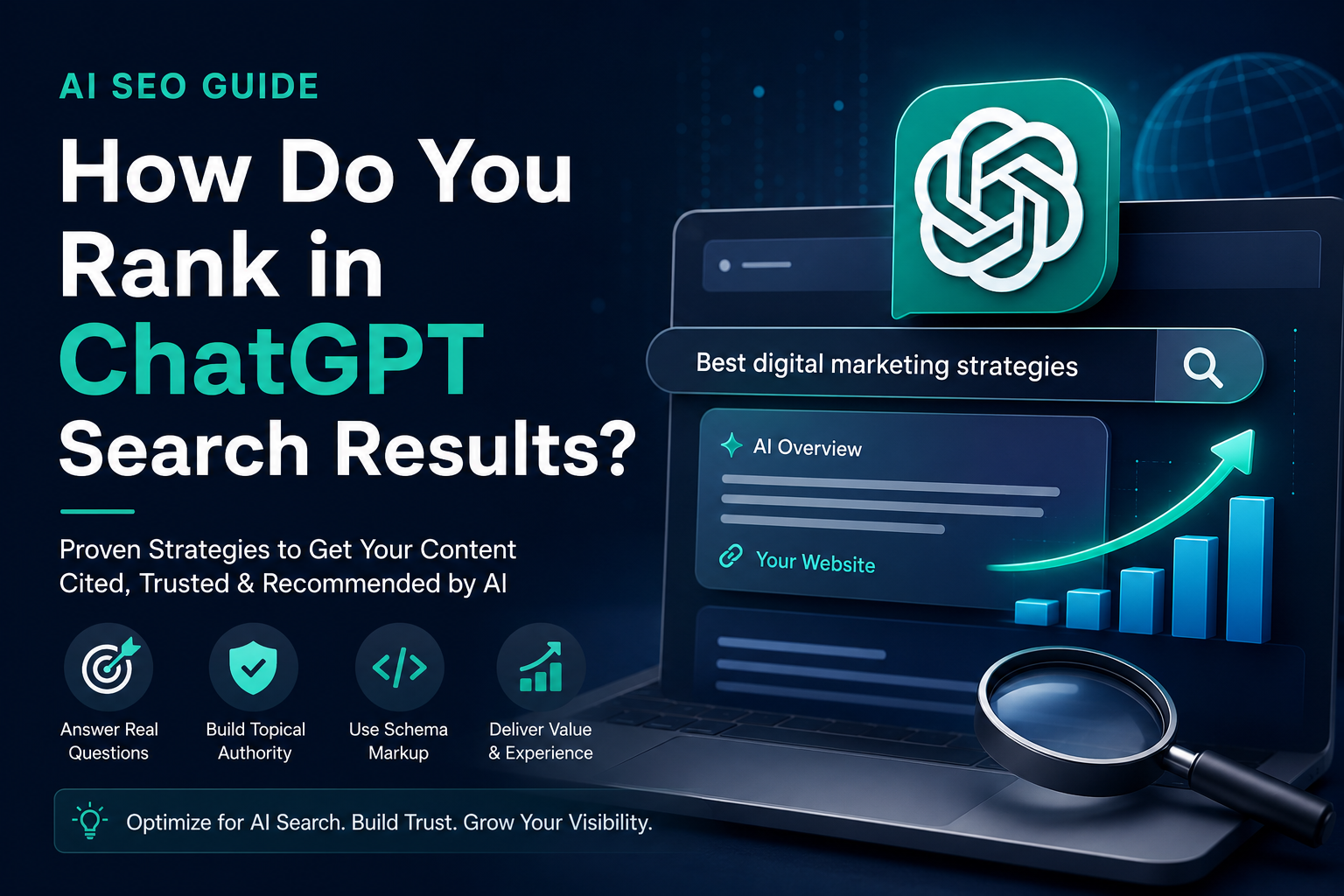
If you’ve been wondering, “How do you rank in ChatGPT search results?” the answer is different from traditional SEO. ChatGPT doesn’t rank websites the same way a search engine does. Instead, it selects information that appears reliable, relevant, accurate, and helpful for the user’s question.
That means creating content for AI search requires more than simply inserting keywords throughout a page. You need to publish content that demonstrates expertise, answers questions completely, uses a logical structure, and provides genuine value.
This guide explains how ChatGPT search works, the factors that influence visibility, and the practical strategies you can use to improve your chances of being mentioned in AI-generated answers.
What Is ChatGPT Search?
ChatGPT Search is an AI-powered search experience that allows users to ask questions naturally, just as they would ask another person. Instead of searching with keywords like “best SEO company,” users ask questions such as:
- Which SEO company is best for small businesses?
- How can I improve my website traffic in 2026?
- What are the best ways to optimize content for AI search?
Rather than displaying hundreds of webpages, ChatGPT analyzes available information and produces a conversational response that combines the most relevant facts.
This approach saves users time because they don’t need to compare multiple websites before finding an answer.
For businesses, however, it means content quality matters more than ever.
Does ChatGPT Have Search Rankings?
The simple answer is no.
Unlike traditional search engines, ChatGPT doesn’t display websites in numerical positions like #1, #2, or #10.
Instead, AI selects information that best answers the user’s question.
Think of ChatGPT as a research assistant. If someone asks a detailed question, the assistant doesn’t randomly choose a website. It looks for information that is:
- Relevant to the question
- Factually accurate
- Easy to understand
- Up to date
- Trustworthy
- Comprehensive
If your content satisfies these qualities better than competing pages, it has a stronger chance of being referenced.
How ChatGPT Chooses Information
Many website owners assume AI simply copies Google’s rankings.
That’s not how it works.
When ChatGPT answers a question, it evaluates information based on context instead of matching exact keywords.
For example, imagine someone asks:
“What should a local business do to appear in AI search results?”
A page that only repeats the phrase “AI search optimization” twenty times may not be useful.
Instead, ChatGPT is more likely to reference an article that explains:
- What AI search is
- Why it matters
- How AI evaluates websites
- Technical SEO requirements
- Content strategies
- Schema markup
- Entity optimization
- Real examples
- Common mistakes
The article that completely answers the question usually provides greater value than one focused only on keyword repetition.
Why Traditional SEO Alone Is No Longer Enough
Traditional SEO remains important because search engines still help users discover websites.
However, AI search introduces a new challenge.
Instead of optimizing only for search engines, you now need to optimize for understanding.
AI doesn’t just scan keywords.
It evaluates relationships between topics.
For example, if your website consistently publishes articles about:
- Technical SEO
- Local SEO
- Content marketing
- Schema markup
- Core Web Vitals
- Google Search Console
- AI SEO
- Generative Engine Optimization
AI begins recognizing your website as a trusted resource within digital marketing.
This is known as topical authority.
The more complete your coverage of a subject, the easier it becomes for AI systems to understand your expertise.
The Five Signals That Build AI Trust
One useful way to think about AI visibility is through five trust signals.
1. Accuracy
Your content should present factual, verified, and current information. Outdated advice or unsupported claims reduce credibility.
2. Expertise
Readers and AI systems both value content written by people with real experience. Share practical knowledge, examples, and lessons learned instead of generic advice.
3. Completeness
A strong article answers follow-up questions before readers need to ask them. Cover the topic from multiple angles rather than providing only a brief overview.
4. Structure
Use descriptive headings, short paragraphs, bullet points, tables, and FAQs. A well-organized page is easier for both humans and AI to understand.
5. Authority
Websites that consistently publish high-quality content, earn mentions from reputable sources, and build a recognizable brand are generally viewed as more trustworthy.
The Difference Between Google SEO and ChatGPT Optimization
Although the two overlap, their primary goals are different.
Google aims to rank webpages.
ChatGPT aims to answer questions.
Google often rewards pages that match search intent and provide a good user experience.
ChatGPT prefers information that can be understood, summarized, and confidently presented as part of a conversational answer.
That means your content should read naturally, answer complete questions, and avoid unnecessary filler.
What Type of Content Performs Best in AI Search?
Not every page has the same chance of being referenced.
Content that tends to perform well includes:
- Detailed how-to guides
- Step-by-step tutorials
- Industry research
- Original case studies
- Expert opinions
- Frequently asked questions
- Comparison articles
- Beginner guides
- Glossaries
- Comprehensive resource pages
These formats help AI understand topics while providing users with complete answers.
Why Original Content Matters
AI search rewards information that adds value.
Publishing another article that repeats advice already available on hundreds of websites rarely creates a competitive advantage.
Instead, include:
- Your own experiences
- Real client examples
- Test results
- Screenshots
- Industry observations
- Practical frameworks
- Original tips
Unique insights make your content more valuable to readers and more distinctive in an increasingly crowded web.
Build Content Around Real Questions
One of the most effective AI SEO strategies is to structure your articles around the questions your audience is actually asking.
Instead of targeting only short keywords, create content that answers complete, conversational queries.
For example:
- How do you rank in ChatGPT search results?
- Can AI replace traditional SEO?
- Does schema markup help AI understand content?
- How often should you update articles for AI search?
- What is the difference between SEO and Generative Engine Optimization?
When your content mirrors the way people naturally ask questions, it becomes more useful for both users and AI-powered search systems.