
Quick Summary
This blog explains how an Uber for home services marketplace can generate revenue through multiple monetization channels, including commissions, customer service fees, dynamic pricing, subscriptions, featured listings, advertising, lead-generation fees, product sales, and B2B contracts. It also explains the money flow, service categories, and how Yo!Gigs can help entrepreneurs launch a ready-made home services marketplace.
On-demand has quietly taken over almost every industry that once relied on phone calls, word-of-mouth, and waiting around. Ride-hailing did it for transportation, food delivery apps did it for restaurants, and now the same pattern is reshaping how people find a plumber, an electrician, a house cleaner, or a beautician. This shift has given rise to what’s commonly called an “Uber for home services” business, a digital marketplace that connects customers with nearby professionals across categories like plumbing, electrical work, cleaning, beauty, handyman services, and appliance repair.
What makes this model interesting from a business standpoint isn’t just the convenience it offers customers. It’s the fact that a well-designed platform doesn’t have to rely on a single revenue source. Instead, it can monetize a service transaction at multiple points from the moment a customer opens the app to long after the job is done.
The real opportunity isn’t simply connecting customers with professionals. It’s monetizing every successful service interaction.
What Is an Uber for Home Services Business Model?
An Uber for home services business model applies the on-demand marketplace concept of ride-hailing to everyday household services. Instead of connecting riders with drivers, the platform connects customers with verified professionals such as plumbers, electricians, cleaners, handymen, beauty professionals, and other service providers.
The basic process is straightforward:
Customer → Home Service App → Service Professional → Service Completion → Payment → Platform Revenue
While the customer journey may look simple, the platform typically operates through a sophisticated three-sided ecosystem:
- Customer App: Allows users to browse services, compare professionals, check availability, book appointments, make payments, and leave ratings or reviews.
- Service Provider App: Enables professionals to create profiles, manage service requests, set availability, accept or reject jobs, track earnings, and communicate with customers.
- Admin Dashboard: Gives platform owners centralized control over bookings, users, professionals, payments, commissions, disputes, service categories, and business analytics.
To keep the marketplace running smoothly, essential capabilities include service discovery, professional matching, appointment scheduling, online payments, ratings and reviews, notifications, real-time job tracking, and automated commission settlement.
The revenue logic is also similar to Uber’s marketplace approach. The platform creates value by efficiently connecting customer demand with available service professionals and earns a fee from the transactions it facilitates. Depending on the business strategy, this can include commissions on completed bookings, customer service fees, provider subscriptions, lead-generation fees, or featured listings.
In short, an Uber for home services platform is not simply a booking app. It is a digital marketplace that coordinates customers, service professionals, payments, and operations in one ecosystem—while generating revenue from the transactions and services it facilitates.
How Does Uber for Home Services Make Money?
This is the central question, and the honest answer is: it rarely relies on just one revenue stream. Here are the most common ways these platforms generate income.
1. Commission on Every Service Booking
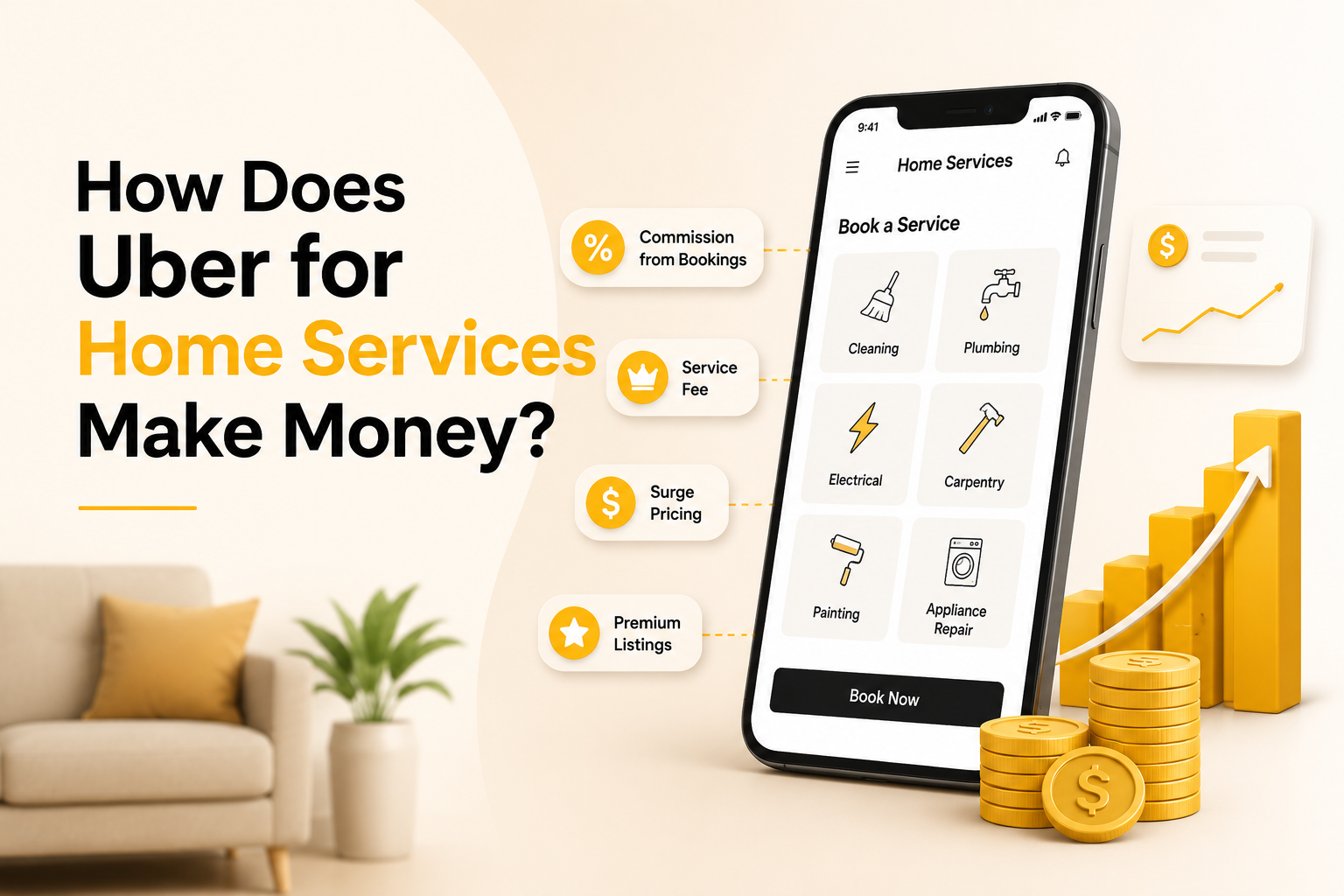
This is the most straightforward and widely used monetization model. The platform charges service professionals a percentage of every completed booking. It’s simple to understand, easy to implement, and directly tied to the value the platform provides — access to customers.
Example: Customer pays $100 → Platform keeps 20% → Professional receives $80
Actual commission rates vary significantly depending on the service category, local market conditions, competition, and the platform’s overall business model. High-skill or emergency services might command different rates than routine cleaning jobs.
2. Customer Service Fees
Beyond taking a cut from professionals, many platforms also add a platform or service fee directly to the customer’s bill. This works especially well in markets where professional commissions alone don’t cover operating costs, or where the platform wants to keep professional payouts competitive to retain talent. It’s a distinct revenue lever from commission — one charges the supply side, the other charges the demand side.
3. Surge or Dynamic Pricing
Just like ride-hailing apps raise prices during high-demand periods, home-services platforms can apply dynamic pricing during peak demand, emergencies, weekends, or holidays. Emergency plumbing at midnight, AC repair in the middle of a heatwave, or last-minute deep cleaning before a guest arrives are all situations where customers are willing to pay a premium for immediate availability. Platforms typically share this additional revenue with the professionals who show up on short notice, which also helps with supply during peak windows.
4. Subscription & Membership Plans
Frequent customers are a platform’s most valuable asset, and subscription plans are designed to lock in that loyalty. A monthly or annual membership can offer reduced service fees, priority bookings, free or discounted visits, and access to exclusive offers. Subscriptions convert unpredictable, one-off bookings into predictable, recurring revenue — a meaningful advantage for financial planning and customer retention.
5. Featured Listings & Professional Subscriptions
Just as advertisers pay for visibility on e-commerce platforms, professionals can pay for higher visibility within a home-services marketplace. This can include featured placement in search results, priority access to leads, premium profile features, and access to a larger volume of customer requests. For professionals competing in a crowded category, this kind of visibility can directly translate into more bookings.
6. Advertising Revenue
A home-services platform sits at the intersection of a large, engaged customer base and a very specific set of purchase intents people who need appliances, cleaning products, plumbing supplies, electrical equipment, smart-home products, or tools. That makes it an attractive advertising channel for relevant brands looking to reach customers exactly when they’re thinking about home maintenance and improvement.
7. Product & Spare-Part Sales
This is an often-overlooked but increasingly important revenue stream. A home-services platform doesn’t have to stop at facilitating labor it can also sell products, tools, consumables, or replacement parts. Urban Company’s model is a good real-world example: alongside its service marketplace, it also sells products directly to customers.
Common examples include AC filters, RO filters, plumbing parts, cleaning supplies, electrical components, and smart-home devices. This stream tends to carry healthy margins and deepens the platform’s relationship with customers beyond a single service visit.
8. Lead Generation Fees
Instead of taking a percentage of a completed transaction, some platforms charge professionals for qualified leads regardless of whether the job converts. The flow looks like this: a customer submits a request, the professional receives the lead, and the professional pays the platform for that opportunity. This model tends to work particularly well for high-ticket or consultation-based services, where the sales cycle is longer and a single lead can be worth pursuing even without a guaranteed booking.
9. Corporate & B2B Service Packages
Individual households aren’t the only customer segment. Offices, hotels, property managers, co-working spaces, retail stores, and real estate companies all need recurring maintenance and cleaning services often at scale. Offering B2B service contracts opens up a more predictable, higher-volume revenue stream that complements the more transactional nature of individual consumer bookings.
How Does the Money Flow in an Uber for Home Services App?
A simple example makes this easier to visualize.
Example: $100 Home Repair Booking
- Customer payment: $100
Possible allocation:
- Professional payout: $80
- Platform commission: $15
- Customer/platform fee: $5
Total platform revenue: $20
Of course, the actual split depends on a range of factors: the platform’s pricing strategy, commission structure, applicable taxes, payment processing costs, ongoing incentives for professionals, and overall market conditions. A platform operating in a highly competitive market might run leaner margins to attract and retain professionals, while one with strong local network effects might command a higher take rate.
What Services Can an Uber for Home Services Platform Offer?
The category breadth is one of the model’s biggest strengths, since it allows a single platform to serve many different customer needs.
Home Maintenance: plumbing, electrical, carpentry, painting, appliance repair
Cleaning: home cleaning, deep cleaning, move-in/move-out cleaning, pest control
Beauty & Wellness: salon at home, massage, makeup, grooming
Installation Services: AC installation, TV installation, furniture assembly, smart-home installation
Specialized Services: handyman work, gardening, laundry, moving assistance
Yo!Gigs: Best Software to Build an Uber for Home Services Marketplace
Building an Uber-like home services marketplace from scratch can be expensive and time-consuming. Yo!Gigs offers a ready-made, white-label, and self-hosted solution that entrepreneurs can customize to launch a marketplace connecting customers with plumbers, electricians, cleaners, handymen, beauty professionals, and other service providers.
Why Yo!Gigs Fits the Home Services Model
Yo!Gigs includes features that support both on-demand service bookings and marketplace monetization, including:
- Job posting & bidding: Customers can post requirements while professionals submit proposals and compete for jobs.
- Direct hiring: Customers can directly hire suitable service providers without going through a bidding process.
- Booking calendar: Professionals can manage availability, while customers can schedule services conveniently.
- Commission management: Admins can configure commissions on completed transactions, supporting a key revenue stream for the marketplace.
- eWallet & payments: Customers and professionals can manage transactions, earnings, and withdrawals within the platform.
- Ratings & reviews: Helps customers evaluate professionals and build trust.
- Messaging: Enables customers and service providers to communicate about job requirements.
- Dispute management: Provides tools for handling conflicts and cancellations.
- Analytics & reports: Helps marketplace owners monitor transactions, revenue, and platform performance.
Launch Without Recurring Software Costs
Yo!Gigs follows a one-time-cost, lifetime-license model and is self-hosted, giving businesses greater control over their platform. It also supports customization, multilingual and multi-currency capabilities, and the official website states that buyers receive 1 year of free technical support.
For entrepreneurs looking to launch an Uber like home services app, Yo!Gigs provides the core technology needed to connect customers and professionals while supporting revenue models such as commissions, paid listings, and service fees.
Conclusion
An Uber for home services platform can generate revenue through far more than booking commissions. Customer service fees, subscriptions, featured listings, lead-generation charges, dynamic pricing, advertising, product sales, and B2B contracts can all contribute to a diversified revenue model. The key is choosing monetization strategies that balance platform profitability with customer value and professional retention.
For entrepreneurs planning to enter this market, building everything from scratch can require significant time, development resources, and investment. Yo!Gigs provides a ready-made, white-label, self-hosted foundation for launching a home services marketplace with features such as job posting, bidding, direct hiring, bookings, payments, commissions, messaging, and reviews.
With the right service categories, pricing strategy, and monetization model, an Uber for home services marketplace can become a scalable digital business rather than simply another booking platform.